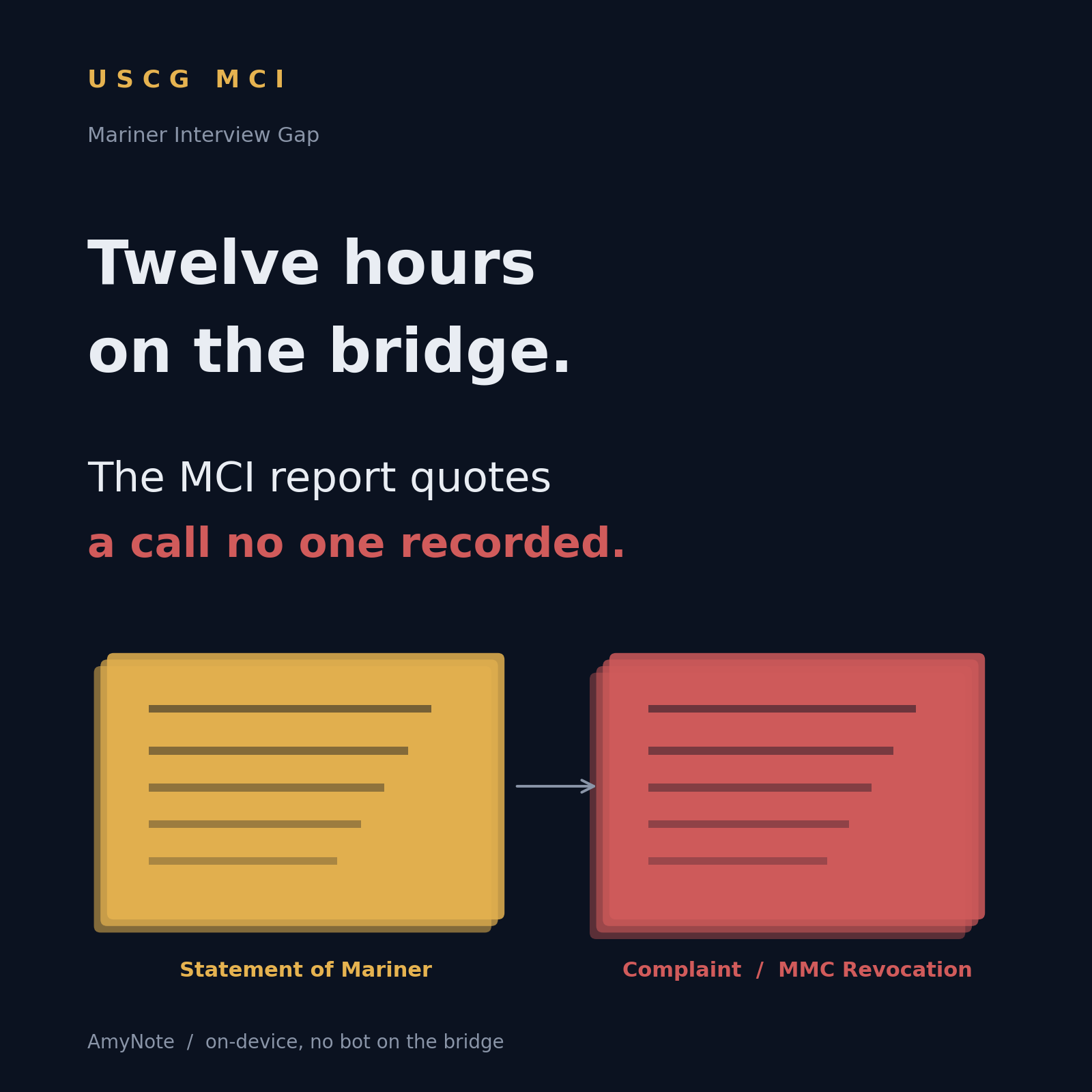
The allision happened at 04:41. You filed the CG-2692 within five hours. Twelve days later a Coast Guard investigator sat you down in a dockside conference room, took handwritten notes, and asked you to sign a two-page Statement of Mariner drafted from those notes. Fourteen months after that, the government's complaint quotes your statement back at you, and you cannot remember whether you actually said "no VHF contact with the pilot" or something a lot more careful.
The Merchant Mariner Credential the government now seeks to suspend was earned across sea time you can count in years, endorsements you tested for twice, and a company safety record you helped build. The Statement of Mariner you signed was drafted by someone else in twenty minutes from handwritten notes. The document that will decide the case does not sound like you, and by the time you notice, it is already Exhibit A.
The Problem
Every reportable marine casualty under 46 CFR Part 4 kicks off the same sequence. The master files a CG-2692 for a Reportable Marine Casualty, or notifies the National Response Center within two hours for a Serious Marine Incident that also triggers mandatory chemical and drug testing under 46 CFR Part 4 Subpart 4.06. A Marine Casualty Investigation Officer opens a case. Days later the MCIO interviews the master, mate, pilot, and any deckhand who was on watch. The interview is not recorded. The MCIO's notes and the drafted Statement of Mariner become the source of record.
Eight to eighteen months later, the MCI Report issues. If the report identifies mariner misconduct, negligence, or incompetence, the Coast Guard files a complaint with the ALJ Docketing Center under 46 U.S.C. 7703. The complaint quotes the mariner's own statement to establish the facts. Suspension and revocation of the Merchant Mariner Credential follows the government's version, not the mariner's memory.
The mariner carries the burden to impeach a statement they signed. Twelve months out, that burden runs against a written signature and no independent record. In an ALJ courtroom that is not a favorable posture. The mariner who wants to argue that the paraphrase changes the meaning of the pilotage question is now testifying against a document they endorsed in ink, without any recording to point to and no VDR audio to play back. The judge reads the statement first. The mariner's live testimony arrives second, with a credibility discount already applied.
Why Current Solutions Fail
Every substitute for a mariner-controlled record has a specific failure mode, and they compound across a Part 4 investigation.
- Bringing counsel is not enough. Counsel can advise the mariner not to sign, but counsel cannot testify to what the master said on the bridge at 04:26. A denial from counsel at the ALJ hearing is not an evidentiary substitute for a contemporaneous audio segment.
- Voyage Data Recorder audio is limited. A VDR is required only on certain SOLAS-class vessels under IMO Resolution A.861(20), and even then bridge audio is captured for a fixed rolling window, typically 12 hours in modern units, that is often overwritten before the MCIO interview happens. On many tugs, towing vessels, small passenger vessels, and inland freighters, no VDR exists at all.
- Handwritten watch logs miss the reasoning. The bell book, engine log, and helm order book record ordered rudder and engine commands but not the reasoning behind them, and not what the pilot advised over VHF 13 between calls. When the Statement of Mariner says the master ignored the pilot's advice, the log entries alone cannot answer.
- Post-casualty dictated memos capture gist not phrasing. A memo dictated the same afternoon by the master to a company safety officer captures the arc of events but not the exact words. When the MCI report cites "master reported no VHF contact with the pilot," the mariner remembers saying "I did not hear a callback on VHF 13 during the turn." Those are not the same sentence, and the ALJ will land on the shorter one.
- Reliance on the MCIO's notes puts the mariner's record in the investigator's hand. The investigator writes the paraphrase, the mariner signs it, and the government cites its own document at the hearing. That is not a defensible chain.
What Actually Works
A contemporaneous on-device record of the bridge team's voice traffic during the casualty, plus a structured debrief within thirty minutes of standdown, is how modern operators close the interview gap. AmyNote records audio directly on the officer's phone or tablet with no bot on the bridge, encrypted cloud processing during recording, and no notice to the pilot or the Coast Guard beyond standard one-party-consent state rules. Audio stays encrypted on device.
Transcription runs against OpenAI's Speech API and an Anthropic Claude Opus structured summary pipeline. Both providers contractually guarantee zero training on user data. Audio is encrypted in transit; processing copies may be retained to deliver and recover requested features. Transcripts and recordings stay locally on the mariner's device with encrypted transport. Speaker identification carries across sessions, so the master, the mate, and the pilot each get their own lane on the transcript without any manual tagging after the fact.
The result is a diarized, timestamped record the master can search by keyword twelve days or eighteen months later. When the MCIO drafts a Statement of Mariner and slides it across the table in a dockside conference room, the master reads it against the actual audio. If the draft paraphrases the VHF exchange in a way that changes the pilotage question, defense counsel amends the statement before it gets signed. If the master's actual words support the paraphrase, the statement gets signed and the mariner has an independent record that corroborates it. Either way, the mariner is no longer testifying from memory against a document written by the investigator.
Company safety officers get an operational debrief that survives crew rotations. Structured entity resolution across VHF channel numbers, ordered rudder angles, engine bell commands, waypoint identifiers, and pilot names makes cross-reference across a multi-hour bridge watch trivial. Outside admiralty counsel does not have to reconstruct a twelve-hour watch from a signed statement, the master's memory, and whatever the VDR happened to preserve.
The Consent Question
State recording consent law applies at the point the audio was captured. In most U.S. states and inland navigable waters, one-party consent applies, meaning the mariner can lawfully record any conversation they are a party to, including their own side of the VHF exchange. In the small set of all-party consent states, the analysis is more nuanced and should run through counsel before the next voyage. On the high seas or in foreign ports the flag-state and coastal-state rules interact, and again the analysis belongs with counsel.
In practice most mariner-controlled recordings live in the mariner's own device and enter the company's file only if and when counsel decides they should. The recording exists first as a personal memory aid. It becomes evidence only when the mariner and counsel choose to introduce it, or when it is properly discovered.
Getting Started
Masters, mates, and pilots working under a Merchant Mariner Credential can install AmyNote on the ship's phone or a personal device before the next voyage. Recording lives inside the operator. No shared workspace, no cross-vessel exposure, no bots on the bridge.
Before the next casualty, test transcription accuracy against the specific vocabulary of your route: VHF channel numbers, ordered rudder angles in degrees, engine bell commands, waypoint identifiers, and pilot names. Confirm that speaker identification separates the master from the pilot when both are on VHF 13. When the next MCIO knocks and asks for a dockside interview, walk in knowing the investigator's notes are no longer the only record of what your team said. That single fact changes the ALJ posture. Any mariner who has read an MCI report written from someone else's memory of the same watch will see the value the first voyage out.
Originally published as an X Article by @AmyNoteApp.