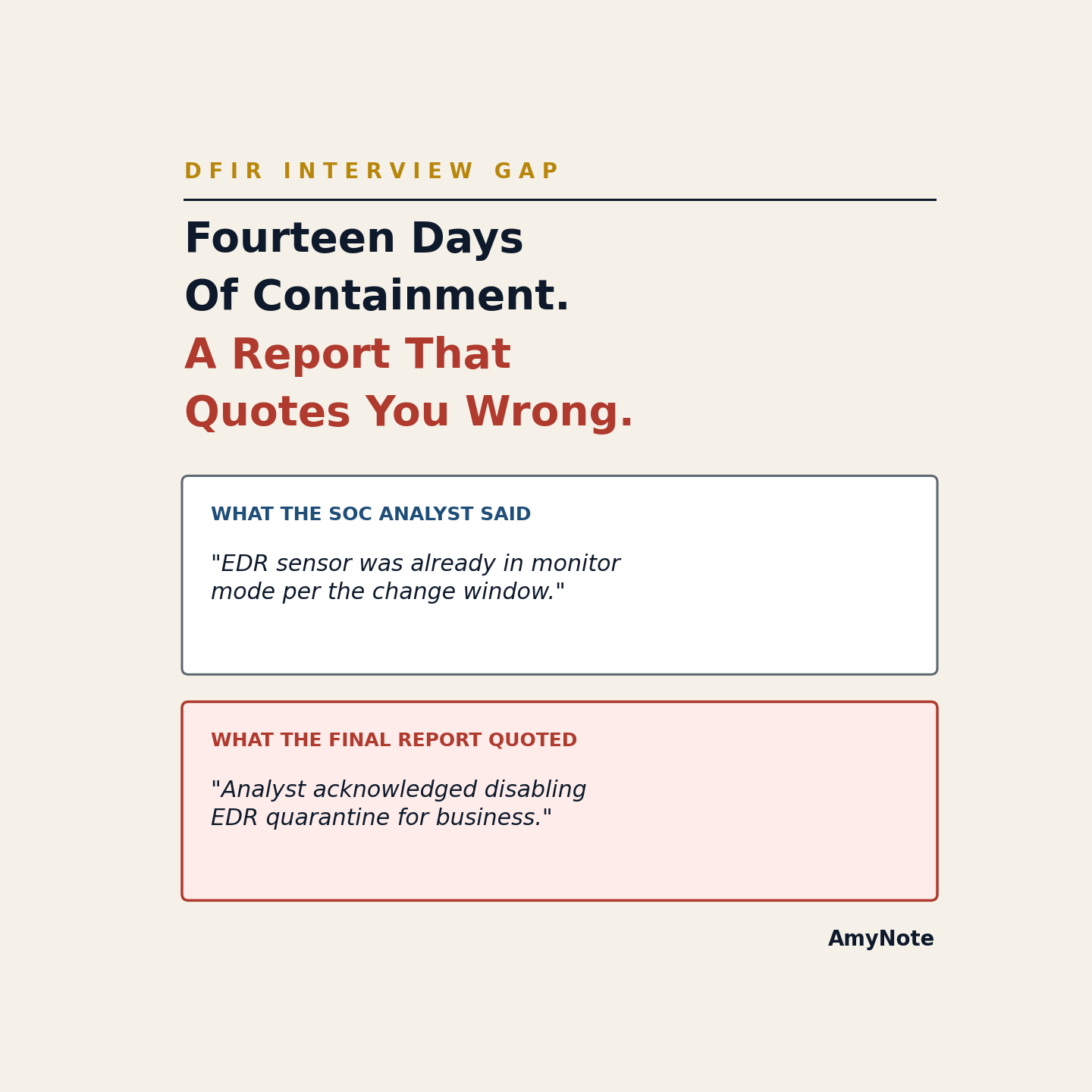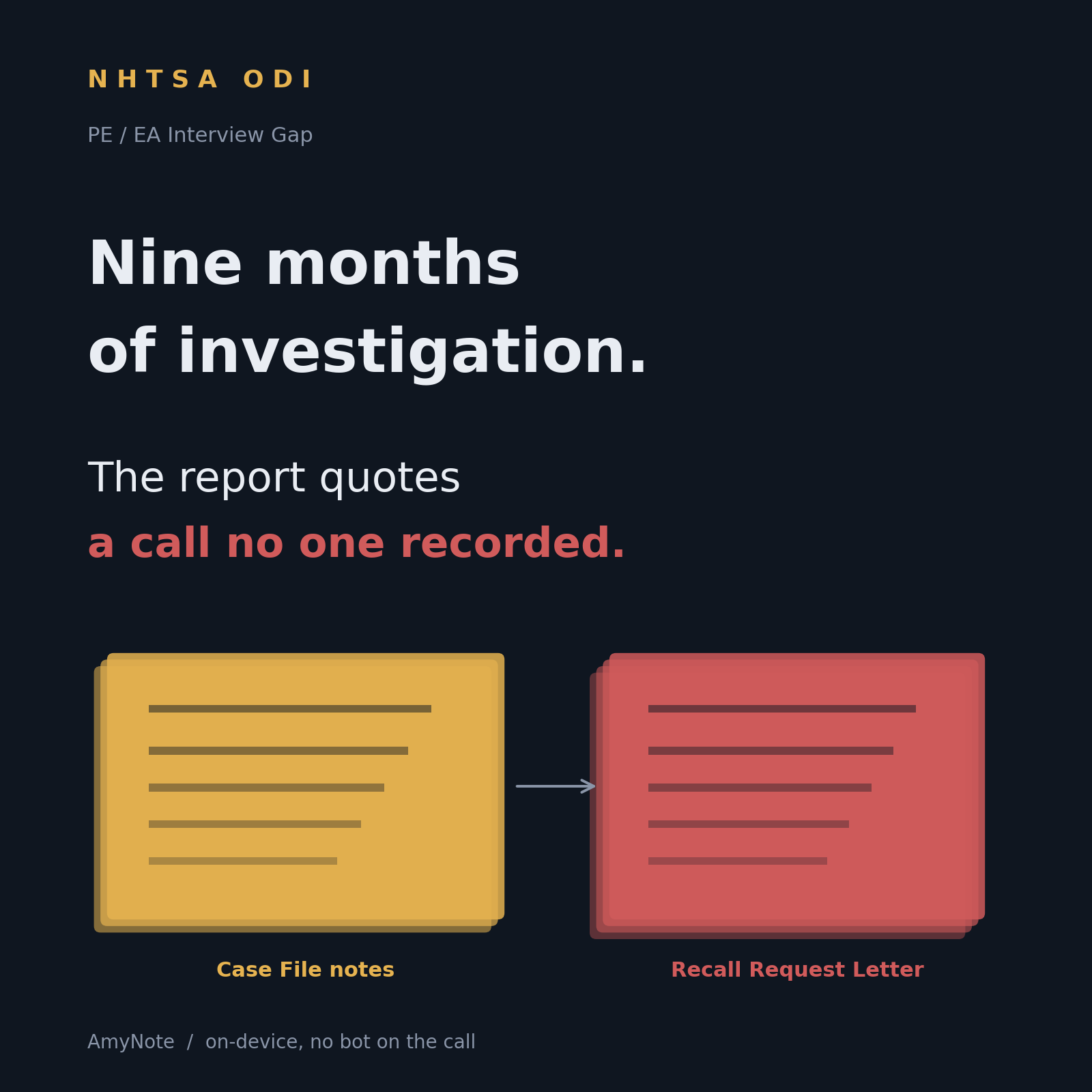
The Information Request Letter arrived nine months ago. Your ODI screening analyst asked three questions on a Teams call, took notes on their side, and hung up. Today the Engineering Analysis report quotes you back at yourself, and you cannot remember whether you actually said "no field failure signature" or something a lot more careful. The plaintiffs' expert has already downloaded the Case File under FOIA. Your outside counsel is asking whether that quote is accurate. You do not know.
The Problem
Every ODI Preliminary Evaluation begins with an Information Request Letter and a follow-up call. The screening analyst walks through the alleged defect trend, and OEM safety counsel or the Product Safety office responds mostly from memory, occasionally with warranty data pulled that morning. The call is not transcribed. The analyst's Case File notes become the source of record.
Nine to fifteen months later, the Engineering Analysis upgrade decision quotes those informal responses in a Recall Request Letter or a Timeliness Query. Plaintiffs' counsel obtains the Case File under FOIA and cross-references OEM 30(b)(6) deposition testimony against the ODI notes. Every recollection drift, every "actually what I meant was," becomes a credibility problem in front of a jury that has been told the OEM knew about the trend the whole time.
The OEM carries the burden under 49 U.S.C. 30118 once the agency issues an Initial Decision that a safety-related defect exists. If your record of what was said differs from ODI's summary, you are litigating both the defect question and your own truthfulness at the same time. In a Recall Request Letter that already reads as an accusation, that credibility gap is expensive to close.
And the gap is not confined to the initial screening call. Every subsequent supplemental question, every clarification exchange with the ODI screening analyst or the Vehicle Research and Test Center engineer, follows the same pattern. Analyst takes notes. OEM responder speaks from memory. Neither side comes away with a verbatim record. By the time the Engineering Analysis upgrade decision is docketed, months of informal exchanges have already been synthesized into agency prose that the OEM had no ability to verify against contemporaneous audio.
Why Current Solutions Fail
Every substitute for a responder-controlled record has a specific failure mode, and they compound over the life of an investigation.
- Cloud bots on regulator calls are a non-starter. Government counsel refuses to be recorded, and the analyst can end the call the moment a bot joins the Teams meeting. Any tool that inserts a visible participant fails the first minute.
- A secretary taking notes by hand cannot capture technical exchanges about failure modes, warranty coding, or field data pulls at the speed the conversation moves. The result is a paraphrase weeks later that the OEM cannot cite against the analyst's own paraphrase.
- Emailed summaries after the fact become discoverable and read as advocacy. The plaintiff's expert deposition asks why the "summary" was written before the answers were verified against the warranty database. That question does not have a good answer.
- Manual memo dictation the same afternoon captures gist but not exact phrasing. When ODI later quotes "no statistically significant trend," you have "we do not see a trend that appears significant on current data." Those are not the same sentence, and the deposition transcript will land on the smaller one.
- Reliance on the analyst's own notes means the OEM's response file cites a paraphrase written by the party asserting the defect. That is not a defensible record.
By the time the Engineering Analysis phase concludes, the OEM Product Safety office has answered dozens of informal questions across a rotating cast of ODI screening analysts and VRTC engineers. None of those exchanges has an OEM-side transcript. The Recall Request Letter cites paraphrases the OEM never verified.
What Actually Works
Contemporaneous, on-device capture of your side of the call, plus a structured post-call debrief within thirty minutes, is how modern product safety offices close the recall drift. AmyNote records audio directly on the responder's laptop with no bot on the call, encrypted cloud processing during recording, and no notice to the other party beyond standard one-party-consent state rules. Audio stays encrypted on device.
Transcription runs against OpenAI Whisper and an Anthropic Claude structured summary pipeline. Both providers contractually guarantee zero training on user data. Audio is encrypted in transit; processing copies may be retained to deliver and recover requested features. Transcripts stored locally on device with encrypted transport. Speaker identification carries across sessions, so the ODI analyst, the OEM responder, and outside counsel each get their own lane on the transcript without any manual tagging weeks later.
The result is a diarized, timestamped record you can search by keyword nine months later. When the EA report cites a statement, you pull the exact minute, the exact phrasing, and the exact context of the analyst's question. If ODI paraphrased in a way that changes the technical meaning, you attach the verbatim segment to your written response before the docket closes. Structured entity resolution across TSB numbers, campaign identifiers, failure mode codes, and VIN ranges makes cross-reference across multiple calls trivial, so a follow-up ODI question about a specific warranty code six months later can be answered against the actual language used earlier, not against a memo written from memory.
Safety counsel gets a defensible record. The Product Safety office keeps institutional memory across analyst rotations at the Vehicle Research and Test Center. Outside counsel does not have to rebuild a timeline from calendar invites and half-remembered call notes when the class action complaint arrives at the same time the Recall Request Letter does.
The Consent Question
State recording consent law applies. Roughly 38 states are one-party consent for in-person and telephone conversations, meaning the OEM responder can lawfully record any conversation they are a party to. Eleven states require all-party consent. Your counsel advises on the rule for your jurisdiction, on whether the recording enters the OEM's privileged file or stays as a personal responder aid, and on the handling once the recording becomes potentially discoverable.
In practice most responder-controlled recordings of ODI screening calls live in the OEM Product Safety office's own file, held under the retention policy that already governs internal defect investigation records. Counsel decides at the end of each investigation whether the recording supports a submission to the docket, an exhibit in a Recall Request Letter response, or simply the responder's own memory when the deposition arrives eighteen months later.
Getting Started
Product safety, homologation, and defect investigation teams already handling Information Request Letters can install AmyNote on the answering engineer's device before the next ODI call. Retention policy stays inside the OEM. No shared workspace, no cross-account exposure, no bots on the line.
Before the next screening call, test transcript accuracy against the specific defect terminology your engineering team uses, from field return coding to TSB numbering conventions. Confirm entity resolution against your warranty database's data model so that VIN ranges, campaign numbers, and failure signatures come through in a form that matches your internal search. When ODI opens the next Preliminary Evaluation, walk in knowing the analyst's Case File is no longer the only record of what your team said. That single fact changes the review cycle. Any recall analyst who has read a Recall Request Letter written from someone else's memory of the same call will see the value the first week.
Originally published as an X Article by @AmyNoteApp.