Everyone shopping for an AI note-taker compares accuracy, price and whether a bot shows up uninvited. Almost nobody asks the question that decides whether the purchase was worth it: six months from now, when you need the thing that was said, is it still there?
It is an easy question to skip during an evaluation, because every product looks identical on it. You record a test meeting, the transcript appears, the summary is good, and nothing about that experience tells you what happens to the recording in month seven. The answer is in the pricing table and the privacy policy, and these three answer it differently enough that it should drive the decision. Every price and quotation below was read off the vendors’ own pages on 22 September 2026.
Quick Verdict
- Read AI if you want a permanent free plan and engagement analytics across Zoom, Teams and Meet, and accept that the recording is not yours to replay until the third tier.
- Circleback if you want the clearest retention ladder here and can pay per seat.
- AmyNote if the recording should live on your own phone rather than on a plan tier, you are on iOS, and a flat annual price beats a certification sheet.
What We Compared
All three transcribe well. Accuracy is rarely why anyone switches. Three narrower questions separate them.
- How long the vendor keeps it. Published in days and years, or not published at all.
- Whether you can get it back. Storage is not playback, and one of these charges extra for the second.
- Who controls the clock. On some plans the retention setting is itself a paid feature.
The second question catches people out most often. It is natural to read a storage commitment as a promise that the material will be available to you, but those are two separate product decisions and at least one vendor here prices them separately. A recording can be retained, counted against a published ceiling, and still be something you cannot open.
Read AI: A Permanent Free Plan That Cannot Replay Anything
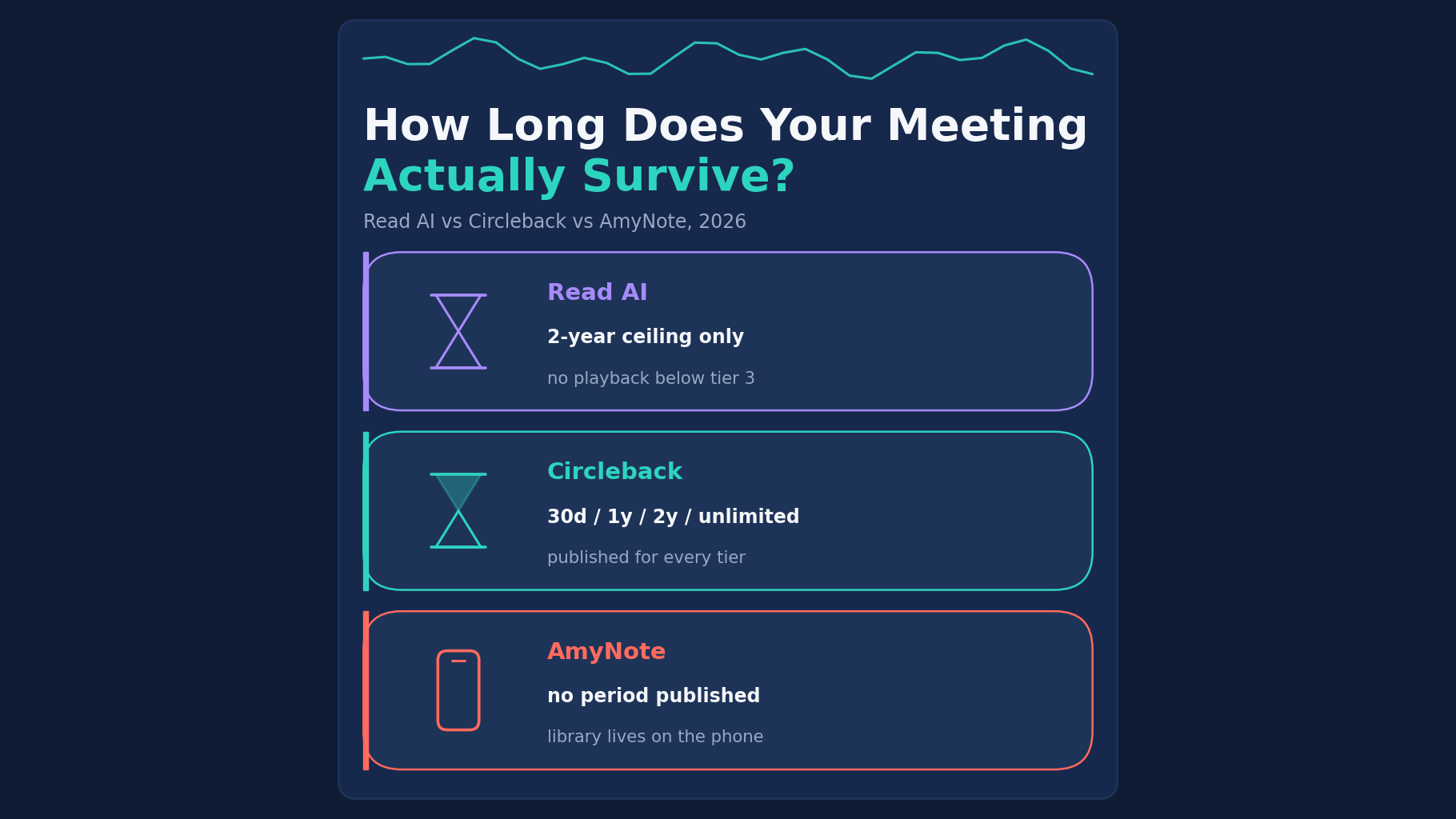
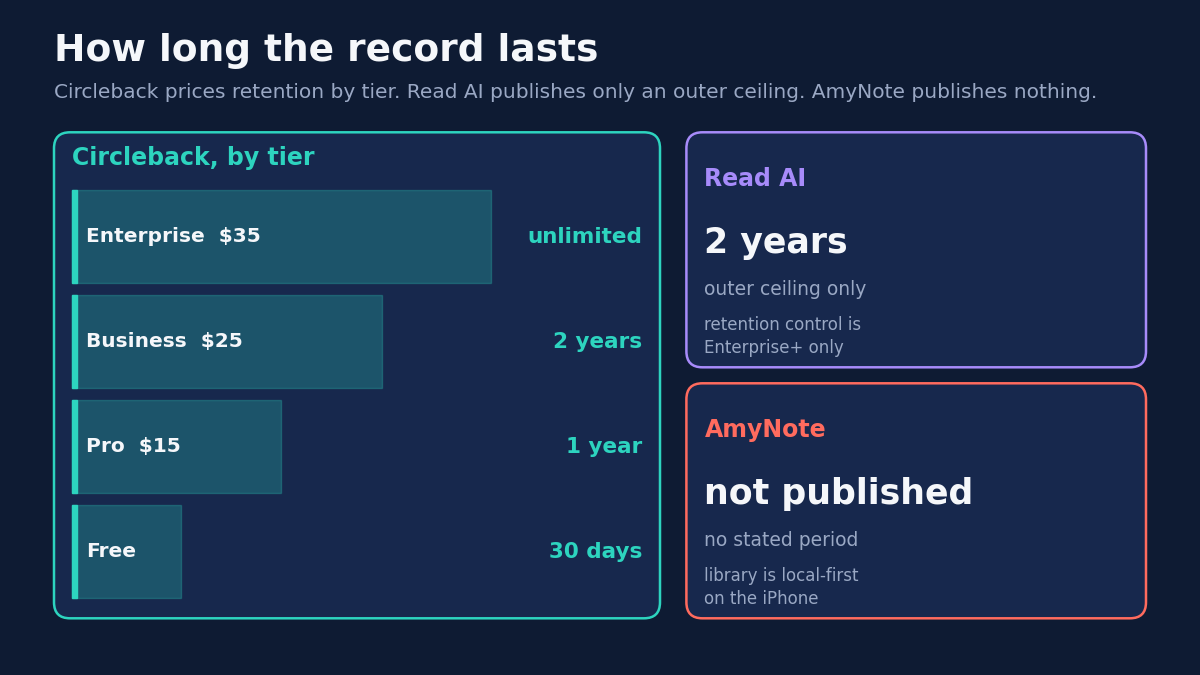
Strengths. Read AI has the broadest platform spread here: Windows, macOS, iOS, Android and a Chrome extension. It prices all four tiers publicly at $15, $22.50 and $29.75 per user monthly billed annually, and the free plan never expires. It is also the only vendor here publishing a hard outer limit, storing audio and video “in no case for longer than 2 years.”
That ceiling deserves credit. A published maximum is something a buyer can hold a vendor to and a compliance team can cite in a policy document, and it is the one row where Read AI beats both competitors outright.
Weaknesses. The retention story falls apart one row below the ceiling. “Audio / Video Playback” is excluded from Free and from Pro, appearing only at Enterprise, so you can pay $15 per user per month and still not replay a word of what was recorded. The self-serve “Data Retention Policy” control is excluded from Free, Pro and Enterprise alike, unlocking only on Enterprise+. Setting your own clock is the most expensive feature in the lineup.
Those two exclusions compound. A buyer on Pro has neither the ability to play the recording back nor the ability to change how long it is kept, which leaves the transcript as the only part of the meeting they can actually reach. If the transcript is all you ever wanted, that is a fair trade. If you bought a recorder expecting to hear the recording, it is not the product you thought you were buying.
The gating pattern repeats elsewhere. The tier named Enterprise does not include Enterprise SSO. SSO and SAML, SCIM and HIPAA compliance are all excluded from Free, Pro and Enterprise, unlocking only on Enterprise+, which the card badges “REQUIRES 5+ LICENSES”. That puts the cheapest configuration carrying Read AI’s own HIPAA claim near $148.75 a month.
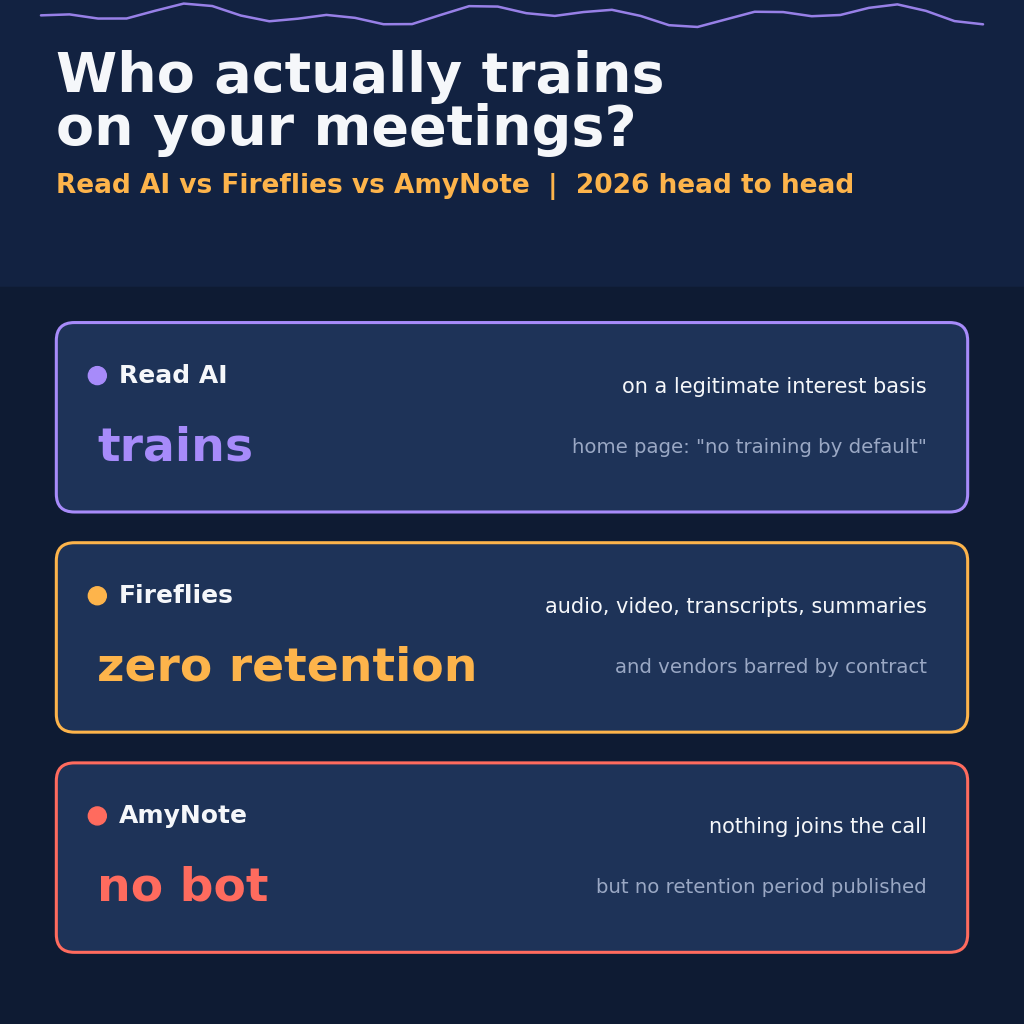
One more thing belongs in the decision. The home page says “SOC II certified, and no training on your data by default”, while the privacy policy lists training “within our Services” on a legitimate interest basis, not consent, and describes a Read Score that “involves analyzing facial and verbal elements of all meeting attendees”, reaching people who never signed up. Those statements can be reconciled, but the reconciliation rests entirely on what “by default” is doing in the first sentence.
Circleback: The Retention Ladder Is the Product
Strengths. Circleback publishes the clearest storage terms of the three, tier by tier: 30 days of meeting and recording history on Free, one year of recording storage on Pro, two years on Business, unlimited on Enterprise. Custom data retention arrives on Business, not at the top of the stack. Pricing is $0, then $15, $25 and $35 per user monthly billed annually, or $18 and $29 monthly for Pro and Business.
Publishing the ladder is a bigger deal than it sounds. It converts retention from a support question into a line item, which means a team can pick the tier that matches the policy it already has rather than discovering the answer after something has aged out.
The free plan is unusually generous. The home page states “Unlimited meetings on the free plan”, and that tier includes in-person meetings, a bot or the bot-free desktop app, mobile and Apple Watch apps, and speaker-labeled transcripts. On training the FAQ is unhedged: “No. We don’t train AI models on customer data.” It supports over 100 languages, and its Enterprise tier actually delivers enterprise features, bundling SSO, SCIM and HIPAA at a published $35 per user.
Weaknesses. It is per seat, so a five person team pays five times. The free plan’s 30 day window is a rolling clock covering recordings and history together, so free users lose the archive continuously rather than at a renewal date. HIPAA still sits on Enterprise behind a sales conversation. And buying more history means upgrading every seat, not just the person who needs the archive — a detail that turns a single compliance requirement into a bill for the whole team.
AmyNote: The Archive Lives on the Phone, Not on a Plan Tier
Strengths. AmyNote is a pure iOS app: in-person conversations need no hardware, video calls need no bot announcing itself. The saved library of recordings, transcripts and notes is local-first on the iPhone or iPad, so the archive is not attached to a subscription tier at all, and playback, reading and export work with no network.
That changes the shape of the retention question rather than answering it. There is no tier to age out of and no ladder to climb, because the material is sitting on a device you own. The trade is that the guarantee is now yours to keep: a device that is lost, wiped or replaced without a backup takes the library with it, where a cloud archive on a published ladder would not.
It transcribes 140 or more languages and translates into 100 or more, the widest coverage here against Read AI’s 16. Transcription runs through OpenAI’s speech services and analysis through Anthropic’s Claude Opus, and both contractually commit to never training on user data. The security page adds that it does not require an account to use core features. Pricing is flat per account, not per seat: $12.99 weekly, $19.99 monthly, $99 yearly.
Weaknesses, stated plainly. On the question this article asks, AmyNote has the weakest paperwork of the three. It publishes no retention period at all. Read AI publishes a two year ceiling and Circleback a four step ladder; buyers who need a written number should mark that against it. AmyNote is also explicit that local-first is not local-only: when transcription, translation or a summary runs, the audio or text is uploaded and a processing copy may be retained on its cloud infrastructure. It encrypts in transit with TLS and specifically declines to call that end-to-end encryption.
The rest of the honest list. AmyNote is iOS only, no Android and no desktop, which disqualifies many teams immediately. There is no free tier, only a three day trial, against permanent free plans from both competitors. It publishes no SOC 2, ISO 27001, HIPAA or GDPR certification and sells no SSO or SCIM at any price. No CRM, no video.
Side by Side
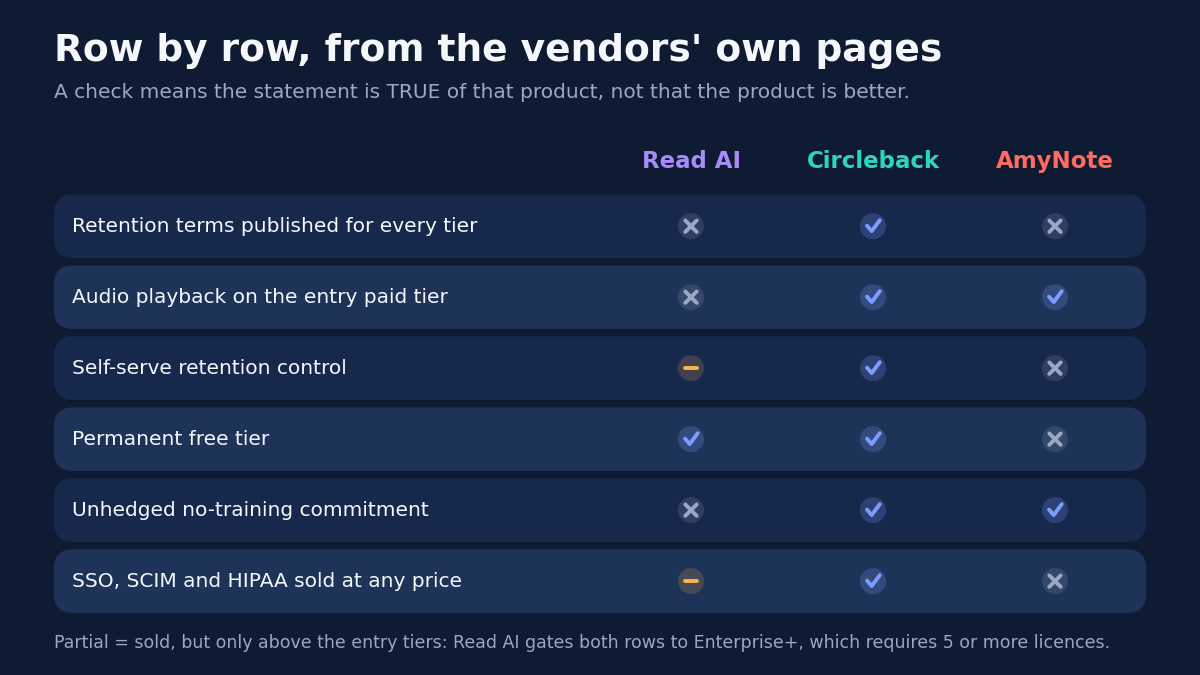
- Published retention terms. Circleback 30 days, 1 year, 2 years, unlimited by tier. Read AI a 2 year outer ceiling. AmyNote none published.
- Audio playback on the entry paid tier. Circleback yes. Read AI no, excluded from Free and Pro. AmyNote yes.
- Self-serve retention control. Circleback on Business at $25. Read AI on Enterprise+ only.
- Permanent free tier. Circleback unlimited meetings, 30 day history. Read AI five transcripts a month. AmyNote none, trial only.
- Unhedged no-training commitment. Circleback and AmyNote yes. Read AI no.
- SSO, SCIM and HIPAA. Circleback on Enterprise at $35 per user. Read AI on Enterprise+ only, near $148.75 a month. AmyNote at no price.
- Transcription languages. Read AI 16. Circleback over 100. AmyNote 140 or more.
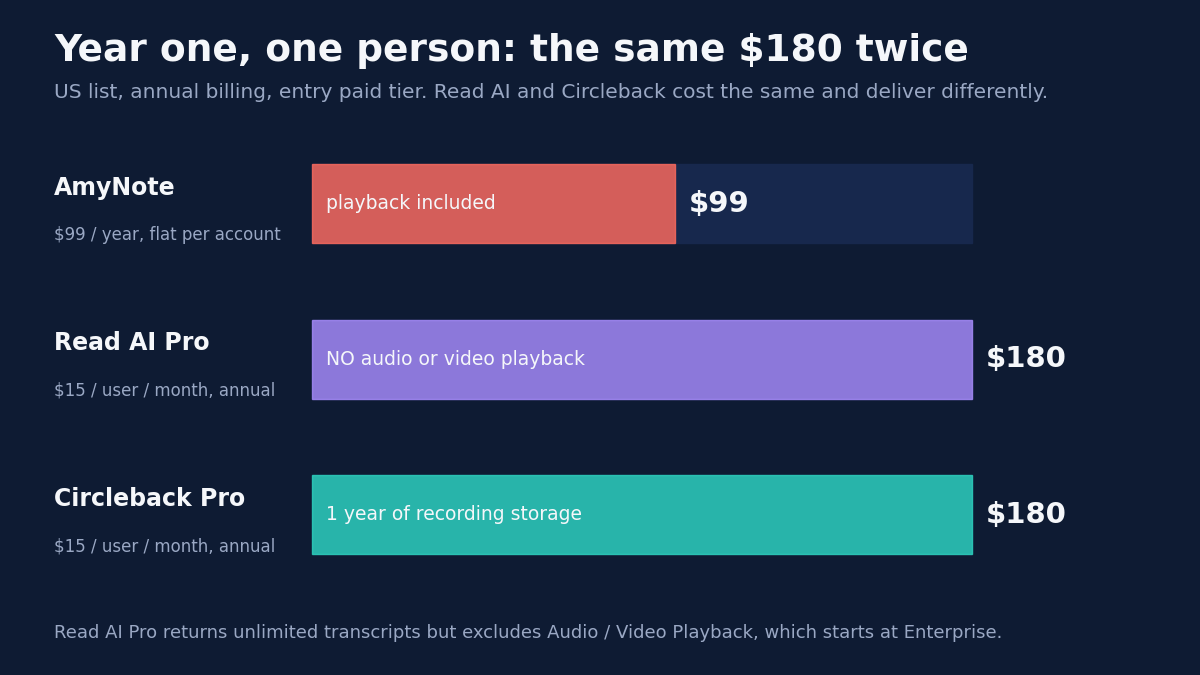
- Year one, one person. AmyNote $99. Read AI Pro $180. Circleback Pro $180.
The Bottom Line
Read AI and Circleback charge the same $180 for a single user’s first year, and that money does not buy the same thing. Circleback gives you a year of recording storage you can actually play back. Read AI gives you unlimited transcripts, no playback until another tier up, and no control over the clock until you buy five seats of Enterprise+.
Circleback is the right answer for most teams needing a written retention commitment. Read AI fits if engagement analytics are the point and five free transcripts a month are enough. AmyNote fits when the archive should not depend on anyone’s plan tier, and when nothing should join the meeting at all.
The useful way to settle it is to work backwards from the obligation rather than forwards from the feature list. If somebody — a client, a regulator, an internal policy — will eventually ask how long you keep recordings, you need a vendor that has already answered in writing, and only two of these three have. If nobody will ever ask, the published ladder is worth less than the thing it is priced against.
Each wins a row the others lose. Circleback publishes the ladder. Read AI publishes the ceiling. AmyNote publishes neither and instead removes the question, at the cost of no free tier, no certifications and iOS only. Decide which of those sentences describes your actual risk, then buy accordingly.
Originally published as an X Article by @AmyNoteApp.