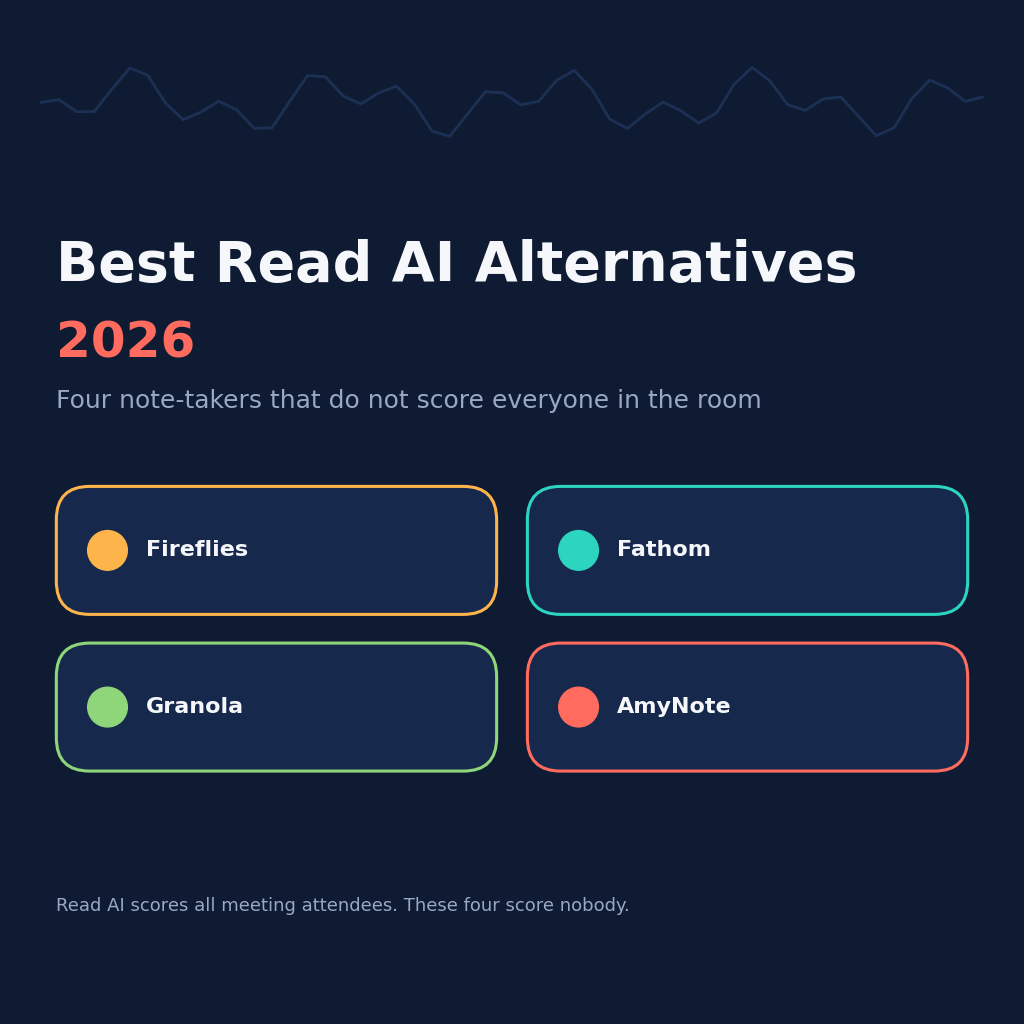
Most people shop for a Read AI alternative after reading one paragraph of its privacy policy. Read AI is a capable product: the broadest platform spread in this category, and a published price on all four tiers. The reason buyers leave is not cost. It is what the policy permits the product to do with everyone else on the call.
That distinction matters, because it changes what you are shopping for. If the objection were price, the answer would be a cheaper tier. If the objection is that the product analyses people who never agreed to be analysed, the answer has to be a product that does not do it at all.
What Read AI Actually Says About Your Meetings
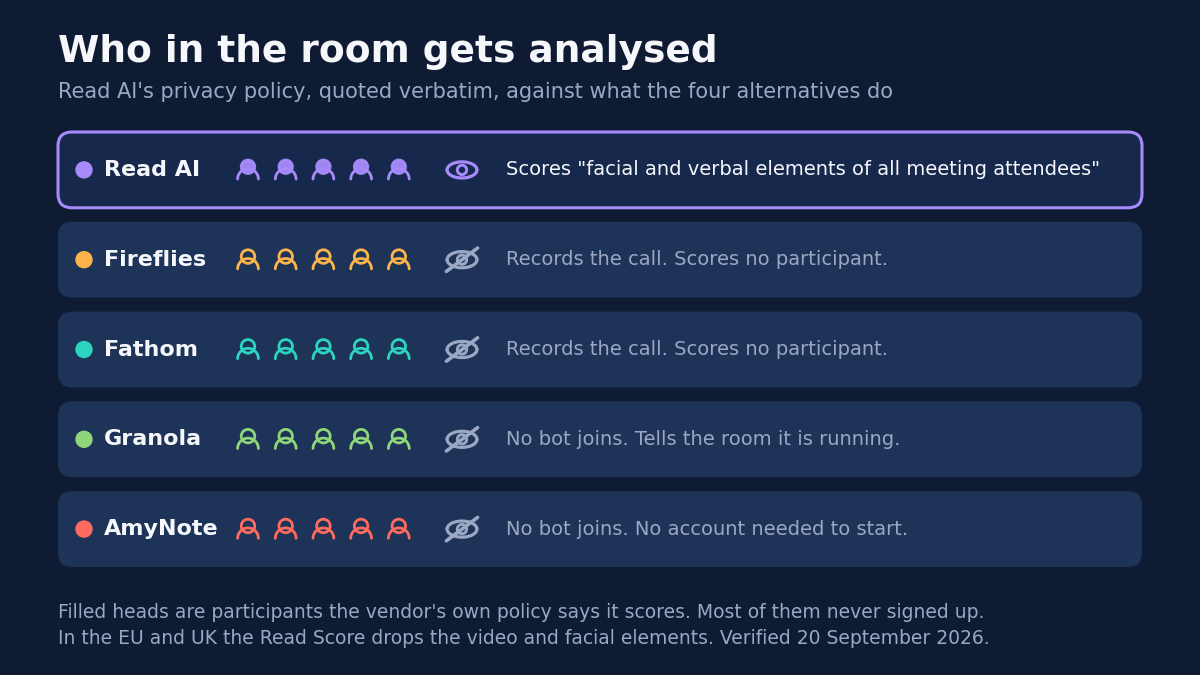
The Read Score reaches people who never signed up. The privacy policy describes a feature that “involves analyzing facial and verbal elements of all meeting attendees” to assess how they are reacting and how engaged they are. Read also uses audio and visual information “as well as other information like language” to infer demographic characteristics about users. In the EU and UK the score drops the video and facial elements.
Read that scope again: all meeting attendees. Not all users, not all subscribers. The external candidate, the client’s counsel and the contractor who joined for fifteen minutes are all inside it, and none of them accepted anything.
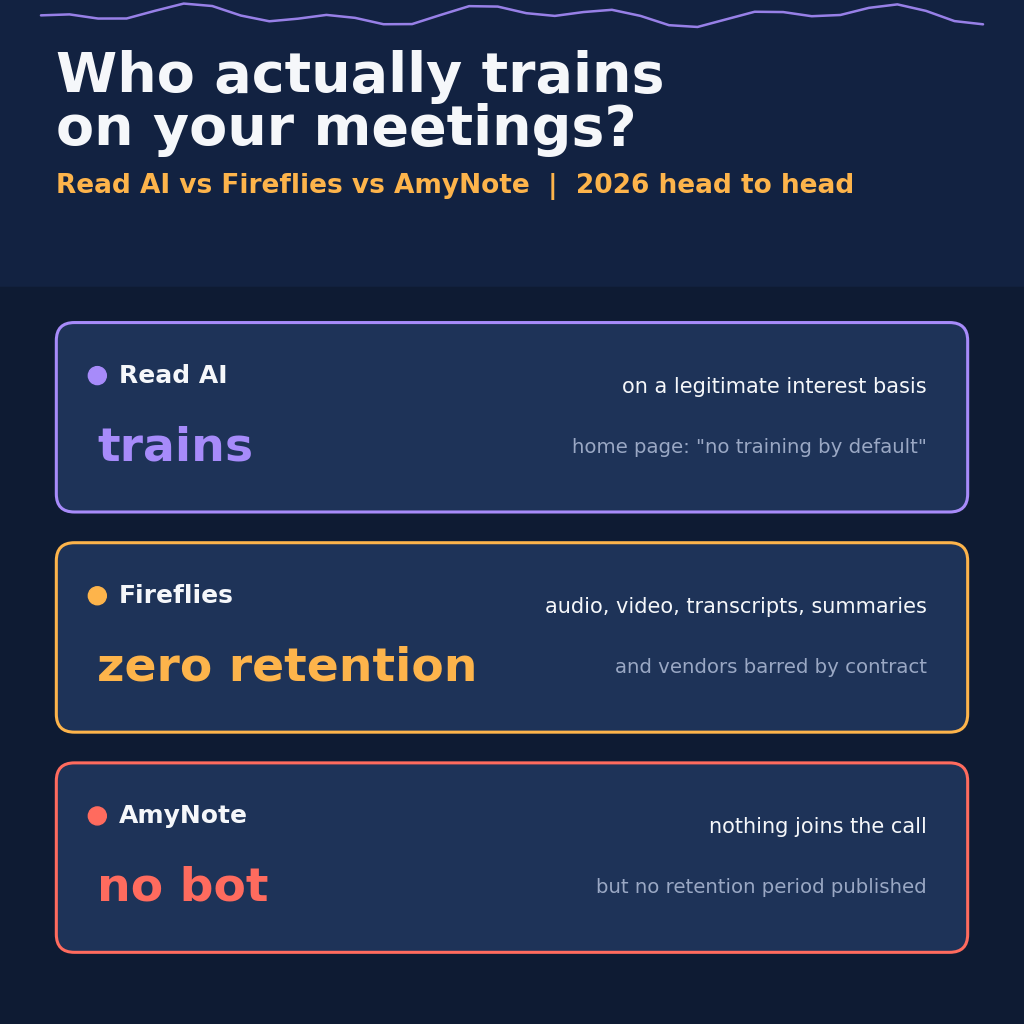
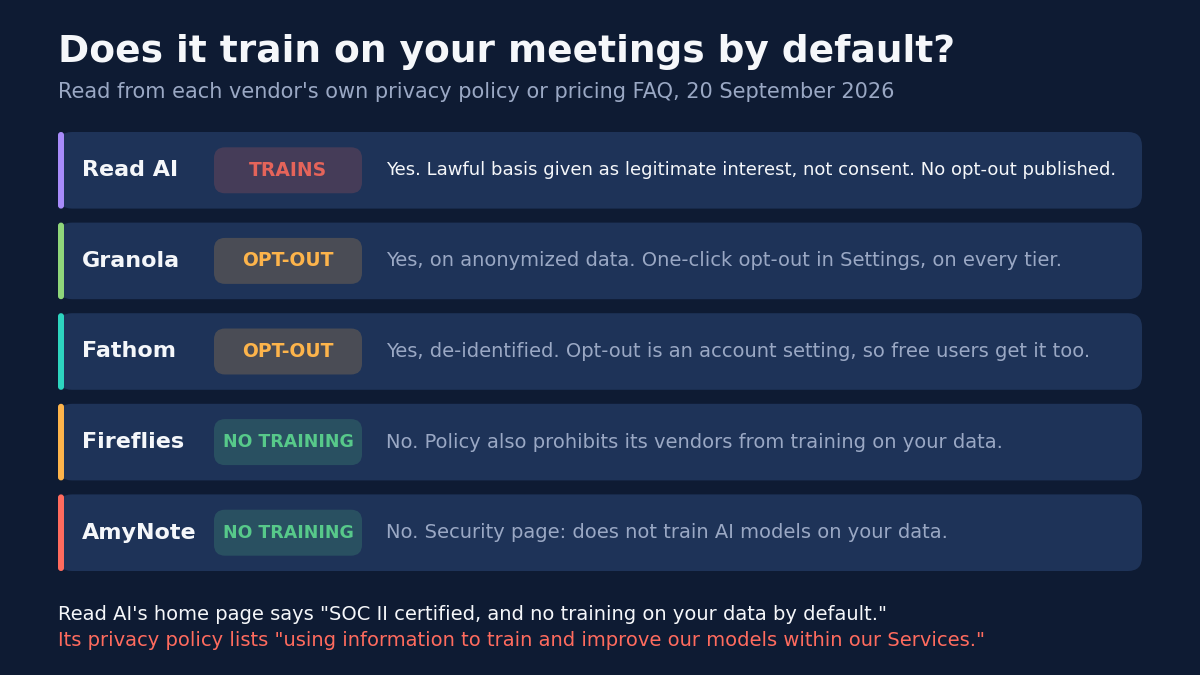
The home page and the policy disagree on training. read.ai says “SOC II certified, and no training on your data by default.” The policy lists among its uses “using information to train and improve our models within our Services”, on a legitimate interest basis, not consent. Legitimate interest is a lawful basis that does not require you to agree; it requires the controller to have weighed its interest against yours.
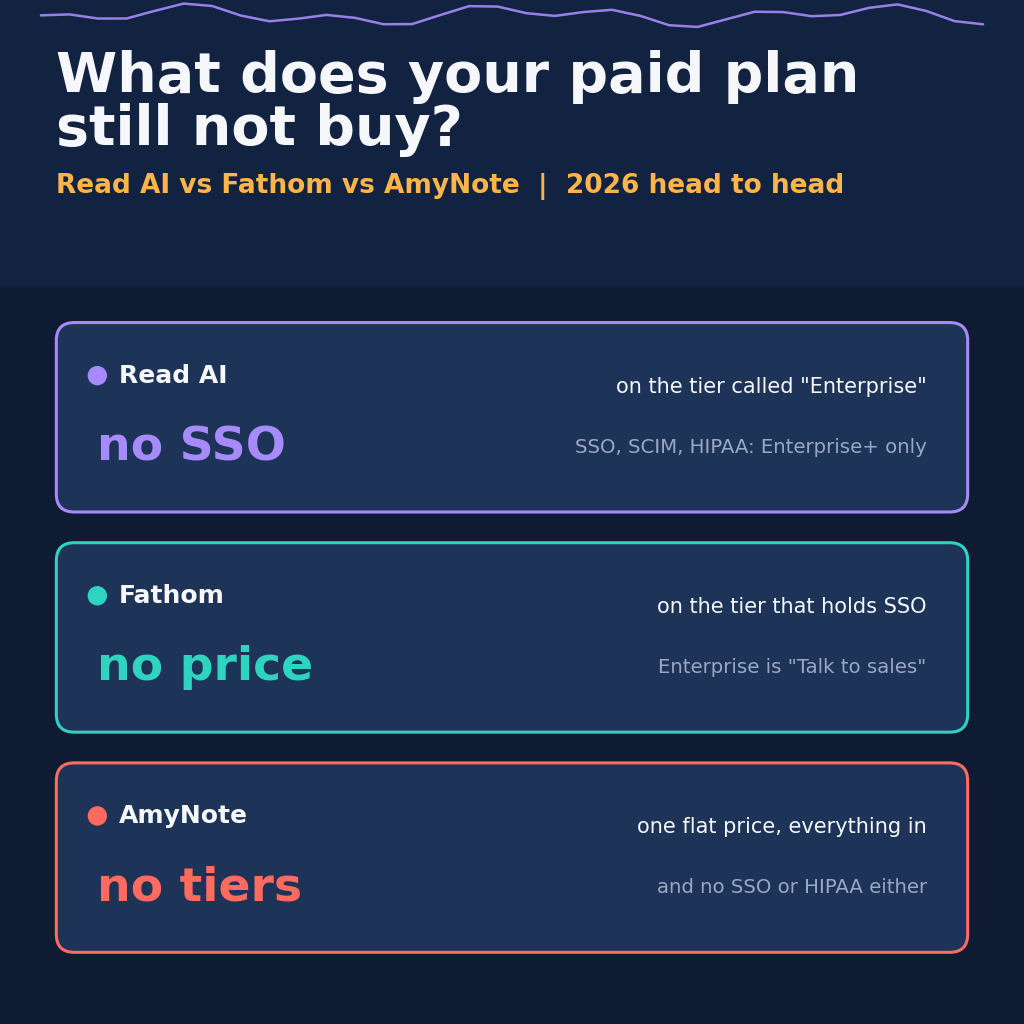
The tier called Enterprise has no Enterprise SSO. The comparison table excludes Enterprise SSO and SAML, SCIM, the Data Retention Policy control and HIPAA Compliance from Free, Pro and Enterprise alike. All four unlock only on Enterprise+, which requires five licences at $29.75 per seat annually. And “30 meetings measured per month” sits under every card, Enterprise+ included, while the free plan returns five transcripts.
Quick Verdict
Fireflies if the paperwork is your filter. Fathom if you want a free plan that is genuinely free. Granola if you want a bot-free notepad that tells the room it is running. AmyNote if nothing should join the meeting at all, including an account. Every price and quotation below was read off the vendors’ own pricing pages, comparison tables and privacy policies on 20 September 2026.
Fireflies: The Strongest Published Commitments
Strengths. The privacy policy states, unhedged: “We do not use personal information for AI model training and we contractually prohibit our vendors from using this information for their own model training.” A Zero Data Retention policy covers audio, video, transcripts and summaries: not stored by a third-party vendor after processing, not used to train internal or external models. Free is real, with unlimited transcription and no monthly rate limit on the bot or Chrome extension. Pro is $10 per seat annually, $18 monthly.
Weaknesses. Read that clause precisely: it is scoped to third-party vendors and to model training, not a promise that Fireflies itself deletes your meetings. Free storage is 400 minutes per team, not per seat. The 100+ languages on the card are qualified by the FAQ: “Currently English is the primarily language that is supported.” Mixed-language meetings need Business at $19 per seat, sign-in is Google or Outlook only, and a visible bot still joins the call.
Fathom: The Free Plan That Does Not Expire
Strengths. Fathom Free gives unlimited recordings and transcriptions with no history window, and lets you pick bot-free capture, in beta, instead of a bot. Fathom may train on de-identified meeting data, but “You can opt out from this use of your data in your account settings”, and because that is an account setting rather than a plan row, free users get it too. Premium is $16 per seat annually, Team $15 with a two-seat minimum.
Weaknesses. Fathom does not capture in-person meetings. That is still coming soon with a waitlist, and the documented Zoom-in-the-room workaround carries Fathom’s own warning that it cannot distinguish between multiple speakers in the same physical room. Translated summaries cover six languages against 38 for transcripts, and only on Premium and Team. Fathom publishes no retention period, and puts both custom retention and a signed HIPAA BAA on Enterprise, the only tier with no published price.
Granola: Bot-Free, and It Tells the Room
Strengths. Granola captures device audio with no bot and layers AI onto notes you type, on macOS, Windows, iOS, Android and Apple Watch. It ships an automated message at the start of each meeting telling other participants it is running, which almost nobody else does. Basic is $0 and caps history rather than meeting count, and even that tier lists “Opt out of model training any time”. Third parties are barred outright: “We do not allow third parties (like OpenAI or Anthropic) to use your data to train their AI models.” Business is $14 per user per month.
Weaknesses. Granola trains on your anonymized data by default, so that one-click opt-out is something you have to remember. Billing is monthly only, with no annual discount anywhere on the page. SSO and org-wide auto-deletion sit on Enterprise at $35, and SSO still carries a 50+ user qualifier. HIPAA now exists, but only for Enterprise customers through sales. The product also assumes you take notes yourself — it is a notepad with AI layered on, not a hands-off recorder.
AmyNote: Nothing Joins the Meeting
Strengths. AmyNote records the room from an iPhone. No bot appears in the call, no participant is scored, and in-person conversations work the same way calls do, which is exactly where Fathom cannot go. Pricing is flat and per account rather than per seat: $12.99 a week, $19.99 a month or $99 a year, every feature included. It transcribes 140+ languages and translates into 100+. Its security page states that it does not sell meeting content, does not train AI models on your data, and does not require an account to use core features.
Weaknesses. On documentation AmyNote loses rows to everything above. It publishes no retention period at all, weaker than Read AI’s two-year ceiling. It holds no SOC 2, ISO 27001, HIPAA or GDPR certification, so what the others gate behind Enterprise, AmyNote does not sell at any price. It is iOS only, with no Android and no desktop app, and there is no free tier, only a 3-day trial. Local-first is not local-only: when transcription or AI analysis runs, audio or text is uploaded and a processing copy may be retained. AmyNote does not claim TLS is end-to-end encryption.
Those are not small gaps, and they decide the shortlist. If a procurement reviewer needs a certification number or a signed BAA, AmyNote is out before the feature comparison starts.
Side by Side
- Who gets analyzed. Read AI scores every attendee. The other four score nobody.
- Training by default. Read AI yes, on legitimate interest. Granola yes, one-click opt-out. Fathom yes, account-level opt-out free users get. Fireflies and AmyNote no.
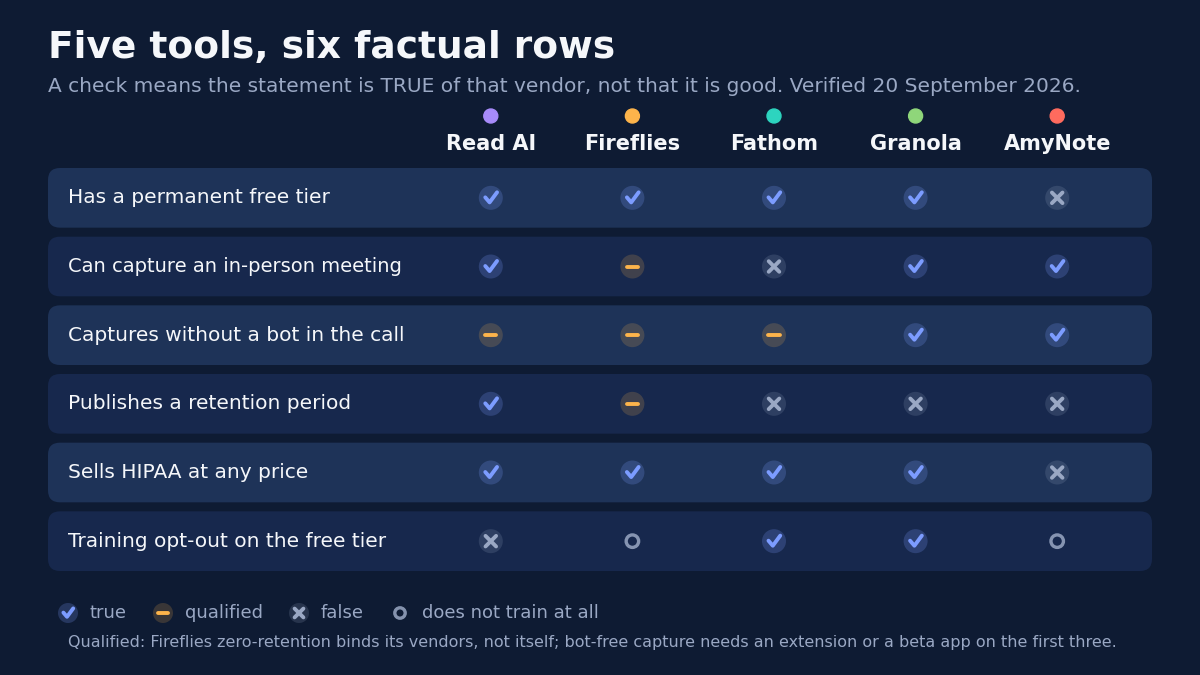
- Free tier. Fathom unlimited recordings forever. Fireflies capped at 400 team minutes of storage. Read AI five transcripts a month. AmyNote has none.
- In-person capture. AmyNote and Granola yes, Read AI yes, Fathom no.
- Retention published. Read AI two years. Fireflies zero retention at vendors. The other three publish no period.
How to Pick in One Question
Decide what the actual objection is, because each of these four answers a different one.
If the objection is reviewable paperwork — a clause someone in procurement has to read and sign off on — Fireflies has the strongest published commitments and the zero-retention policy to point at. If the objection is cost on a small team, Fathom’s free plan is the only one here with no history window and an opt-out that free users actually get. If the objection is the bot in the call, Granola removes it and, unusually, announces itself to the room. If the objection is that anything at all joins the meeting — including an account, including a participant list — AmyNote is the only one of the five that never appears in the call in any form.
The Bottom Line
Leave Read AI for Fireflies if a procurement reviewer has to read the clause, for Fathom if the free tier is doing the work and you want the opt-out without an invoice, and for Granola if you want notes without a bot plus a message that tells the room.
Leave for AmyNote if the real objection was that anything joins the meeting at all. One flat price at amynote.app covers every feature, with no seats and no account needed to start. Transcription runs on OpenAI’s Speech API and analysis on Anthropic’s Claude Opus, both contractually barred from training on customer data. The 3-day trial takes no credit card. Read the honest list first: iOS only, no certifications, no published retention period.
Originally published as an X Article by @AmyNoteApp.