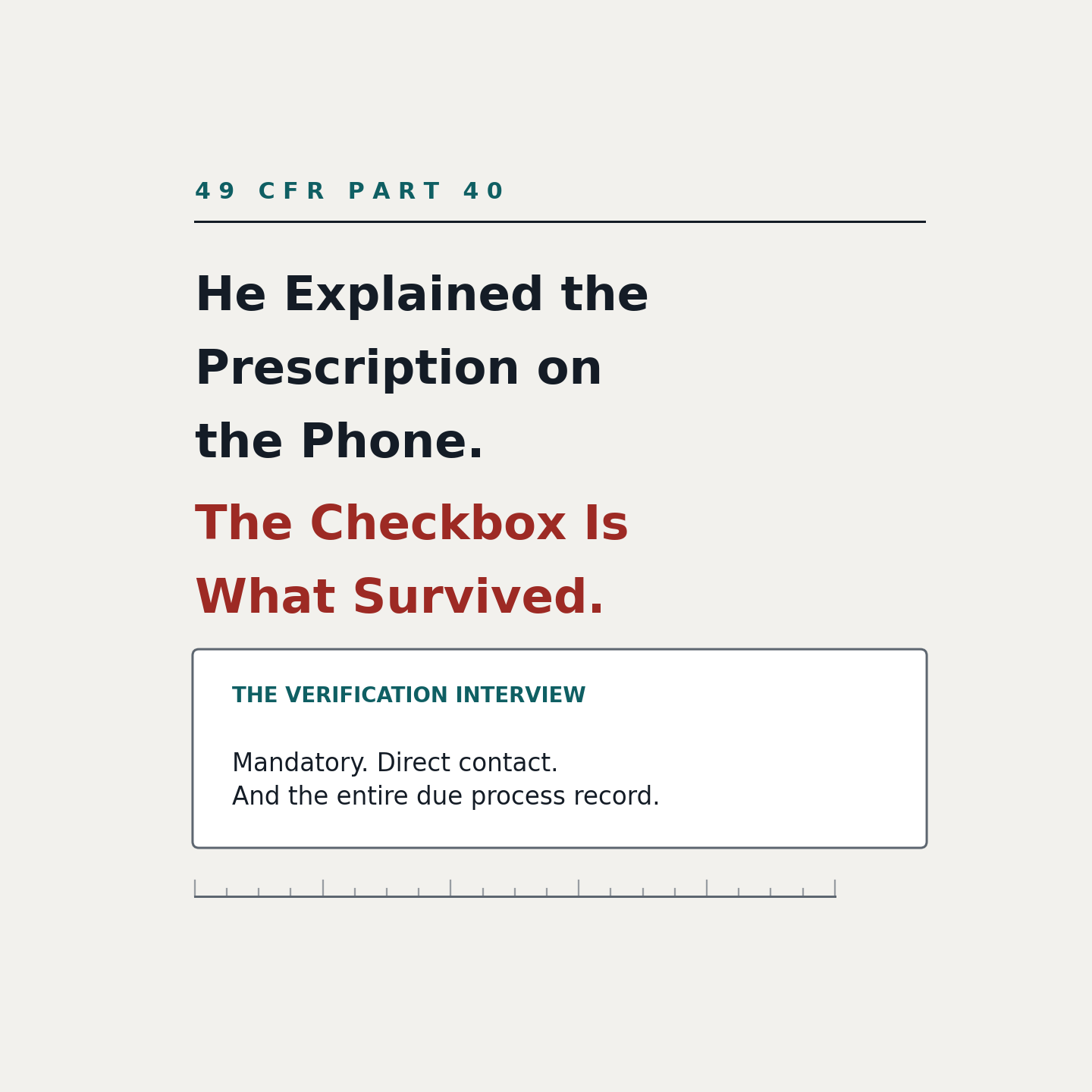
A confirmed positive for oxycodone lands on your desk on a Tuesday afternoon. You reach the driver at the evening number on the third try, and he starts talking before you have finished the first disclosure: the shoulder surgery in February, the surgeon’s name, the pharmacy on Route 9, the date it was filled, the fact that he switched off the generic because of a reaction.
Forty minutes and three calls later, the record of that conversation is a checked box on the Custody and Control Form and six words on a Remarks line. The call decided the outcome. The form is what survives.
The Interview Is the Whole Decision
Under 49 CFR 40.129(a)(4), a Medical Review Officer may not verify a confirmed positive, adulterated, substituted, or invalid result without conducting a verification interview, and that interview requires direct contact, in person or by telephone, between the MRO and the employee. Not a letter. Not a form the donor fills out and faxes back. A conversation.
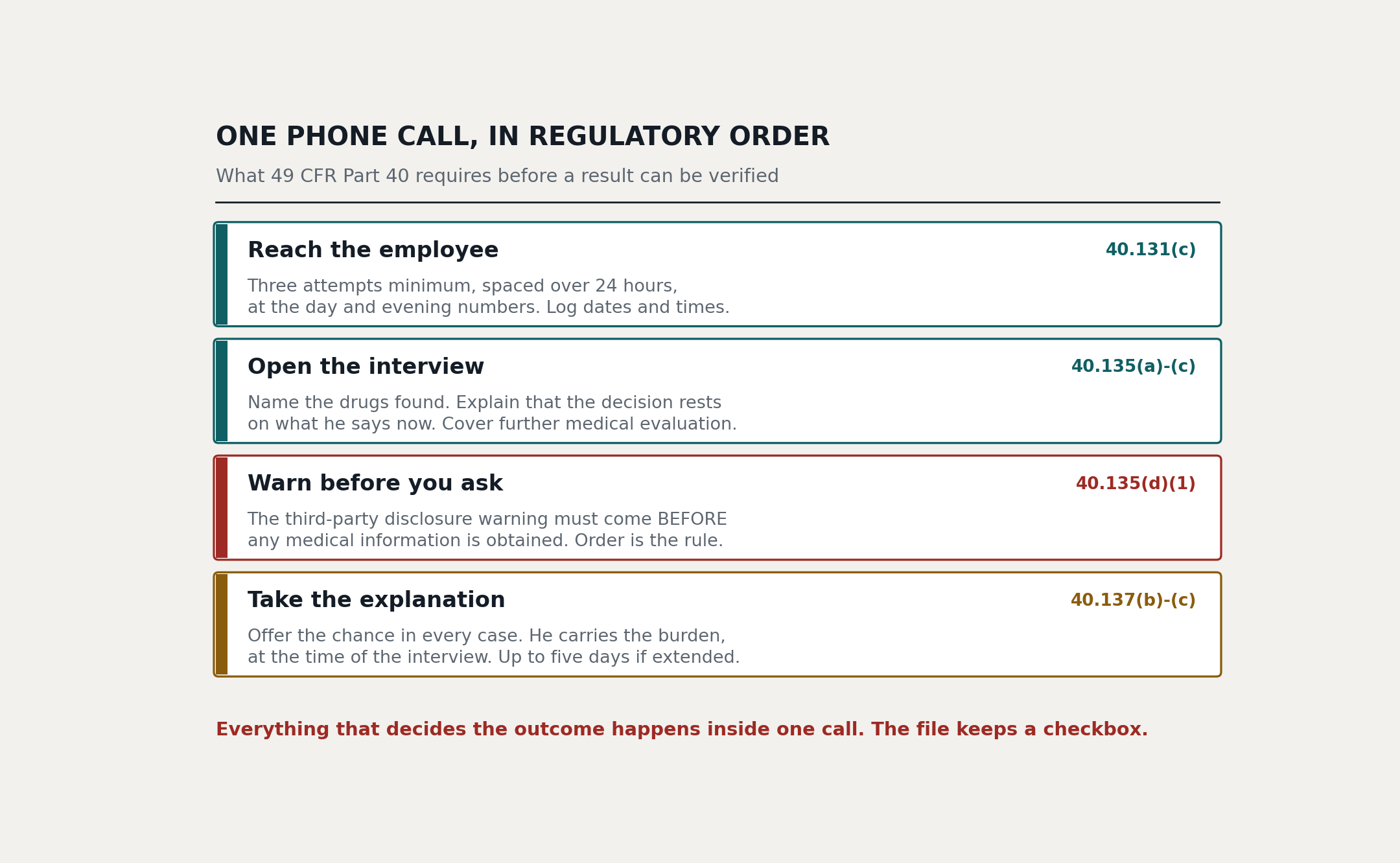
What you have to say before the employee says anything is itself a script, and the order is part of the rule. Section 40.135(a) requires telling the employee which drugs the specimen tested positive for. 40.135(b) requires explaining that your decision will be based on the information the employee provides in the interview. 40.135(c) covers further medical evaluation. And 40.135(d)(1) requires warning the employee about third-party disclosure under 40.327 before obtaining any medical information — not at the end of the call, and not in a follow-up letter.
Then the burden flips. Under 40.137(b) you must offer the opportunity to present a legitimate medical explanation in every case, and under 40.137(c) the employee carries the burden of proof and must meet it at the time of the verification interview. You may extend that window up to five days if there is a reasonable basis to believe the evidence is coming.
Read those provisions together and the shape of the problem shows up. Everything that determines whether a career continues happens inside one phone call: what you disclosed, in what order, what he claimed, what he could not produce, and whether you gave him the time the rule allows.
The Form Was Never Built to Hold It
The Custody and Control Form gives you a checkbox and a Remarks line. Part 40 asks for a great deal more record than that, and it asks for it in places the CCF has no field for.
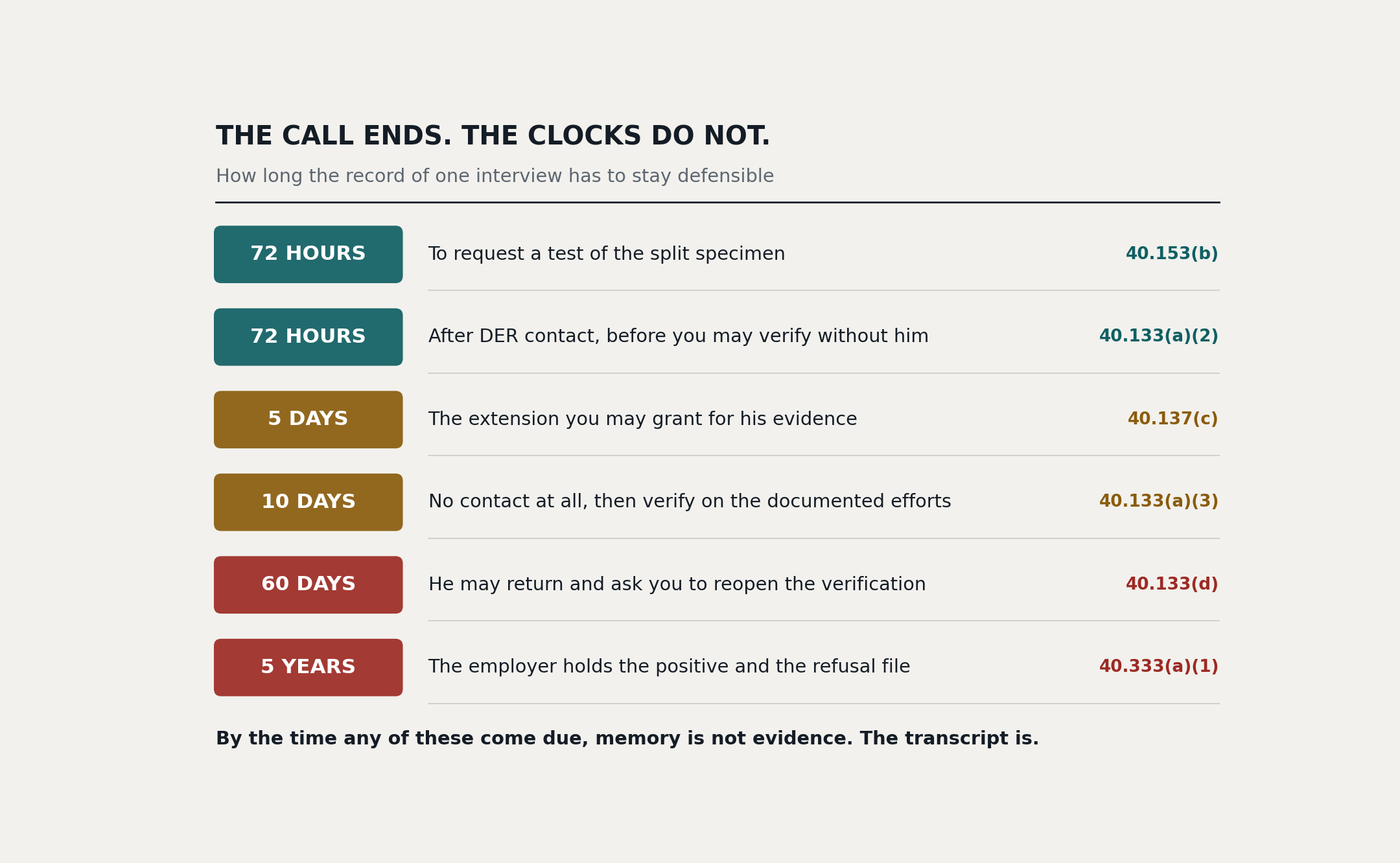
40.131(c) sets reasonable efforts at a minimum of three attempts, spaced reasonably over a 24-hour period, at the day and evening numbers listed on the CCF, with the efforts documented including dates and times. 40.133(a)(1) requires complete documentation when an employee expressly declines to discuss the result, including a notation that you informed or attempted to inform him of the consequences. 40.133(c) requires the date, the time, and the reason.
Notice what kind of facts those are. They are not clinical findings. They are facts about the conduct of a conversation — whether it happened, when, with whom, what was said first, and what the person on the other end refused to say. A form designed to track a specimen has no natural place to put any of it.
What a defensible file has to show, months after the call:
- Contact effort. Which numbers you tried, on what dates, at what times, and when you handed it to the DER.
- The disclosures. That the 40.327 warning came before any medical information, not after it.
- The explanation. What the employee actually claimed, in his words, rather than summarized into a conclusion.
- The clock. Whether you extended time, how much, and what arrived before it ran out.
The third one is where reconstruction hurts most. “Claimed valid prescription, unable to verify” is a conclusion, and it reads as one. What the employee said was that he had a prescription from a surgeon whose name he could half remember, filled at a pharmacy he could describe by its cross street, some time in the spring. Those are two different records, and only one of them explains the decision to a reader who was not on the call.
And the record has to outlive the call by years. 40.133(d) lets the employee come back within 60 days and ask you to reopen the verification. 40.153(b) gives him 72 hours to request a test of the split specimen. 40.333(a)(1) makes the employer hold verified positives and refusal documentation for five years. Arbitration, the union grievance, and the wrongful-termination claim all arrive later than any of those.
By the time the file is read, that interview is one of hundreds you have conducted. Nothing about it stands out except what you wrote down, and what you wrote down was written in the ninety seconds after you hung up, while the next call was already ringing.
Capture the Call, Not the Aftermath
The fix is not a better form. It is capturing the conversation while it is happening, so the write-up becomes a review task instead of a recall task. The medical judgment stays yours. What changes is the material you exercise it over.
AmyNote records the verification interview and transcribes it with the OpenAI Speech API, then uses Anthropic Claude Opus to pull structured detail out of what was actually said: which 40.135 disclosures you gave and in what order, the explanation the employee offered, the prescriber and pharmacy he named, the documents he promised, whether you granted the five-day extension, and the point where you delivered the split-specimen notice.
Speaker separation carries more weight here than it does in an ordinary meeting. The distinction the file has to preserve is between what the MRO disclosed and what the employee asserted — your 40.135 script on one side, his 40.137(c) burden on the other. An undifferentiated block of text collapses exactly the line that matters when the record is read back a year later.
Search matters as much as capture. Semantic search across past interviews finds the one where a driver named the same clinic, or the call where you extended time and the evidence never came. At the volume a busy MRO practice or TPA runs, a searchable corpus is the only realistic way to answer a question about a pattern rather than about a single file.
On privacy: both OpenAI and Anthropic contractually guarantee zero training on user data. Audio is encrypted in transit and not retained after processing. Transcripts are stored locally on device with end-to-end encryption. For a role that handles protected medical information under a disclosure rule as narrow as 40.327, where the data rests is not a detail.
Getting Started
Run it on the next confirmed non-negative you review. Take your notes exactly as you do now, then compare them against the transcript before you sign Step 6. Do not change the process on the first pass — just put the two records side by side.
The gap you find is the gap that would have been in the file five years from now, when someone else reads it with a very different set of questions. AmyNote works on the phone call, in person, and across languages, which covers most of the interviews an MRO actually conducts — including the ones where the employee’s English is not the language he would choose to explain a prescription in.
Originally published as an X Article by @AmyNoteApp.