A litigator spends Monday on a three-hour client prep, Tuesday at a mediation with no laptop open, and Wednesday on a Teams call with opposing counsel. Two weeks later the client remembers the settlement range differently. The lawyer needs the exact words, and needs to know where those words have been.
Most “best AI note-taker” roundups grade summaries, integrations and how polished the action items look. Lawyers grade something else first: how long one recording can run, who processes the client’s words, whether the audio survives for replay, and what the firm’s security review will ask for before anyone is allowed to install the tool. Those four questions reorder the field.
Quick Verdict
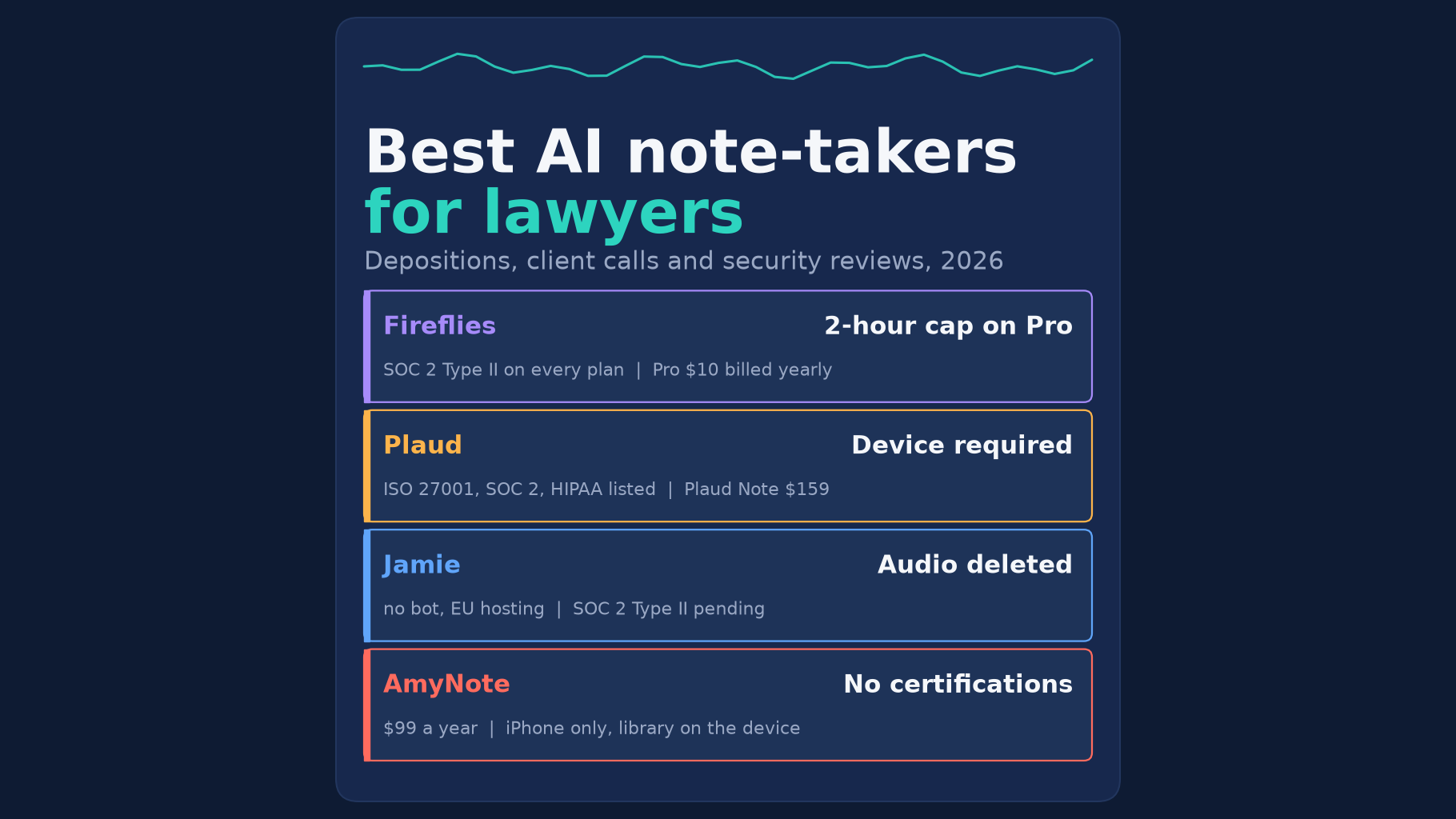
- Best for a firm that lives on video calls: Fireflies. SOC 2 Type II on every plan and a written no-training policy, but Free and Pro stop each recording at 2 hours.
- Best for depositions and in-person meetings, with paperwork: Plaud. It lists ISO 27001, SOC 2 Type II and HIPAA across its plans. You must buy a device first.
- Best for confidentiality-first European practices: Jamie. No bot, EU hosting, ISO 27001, and audio deleted after transcription, which also means no tape to replay.
- Cheapest phone-only option for a solo practitioner: AmyNote. It costs $99 a year, uses no bot and keeps the library on the iPhone. It holds no security certification, so it will not pass a formal firm review.
What We Compared
We read each vendor’s own pricing page, security page and privacy policy on October 11, 2026. We scored four things a law practice actually feels:
- Session length. Depositions, mediations and client interviews run long, and a recording that stops halfway is worse than no recording.
- Where the meeting happens. A video call, a conference room or a courthouse hallway.
- What happens to the client’s words. Training, retention and whether the audio survives.
- What a security review will ask for. SOC 2, ISO 27001, HIPAA and SSO.
Every price below is a list price as printed by the vendor on that date, using annual billing where offered. Jamie prices in euros, and we show them as euros rather than converting. Plans change often, so treat the figures as a snapshot and check the vendor’s page before you sign.
None of these tools replaces a firm’s judgment on privilege and consent. All four send audio or text to cloud services at some point, so the questions below are about how they handle that, not whether they do.
Fireflies: Strong Paperwork, Short Recordings
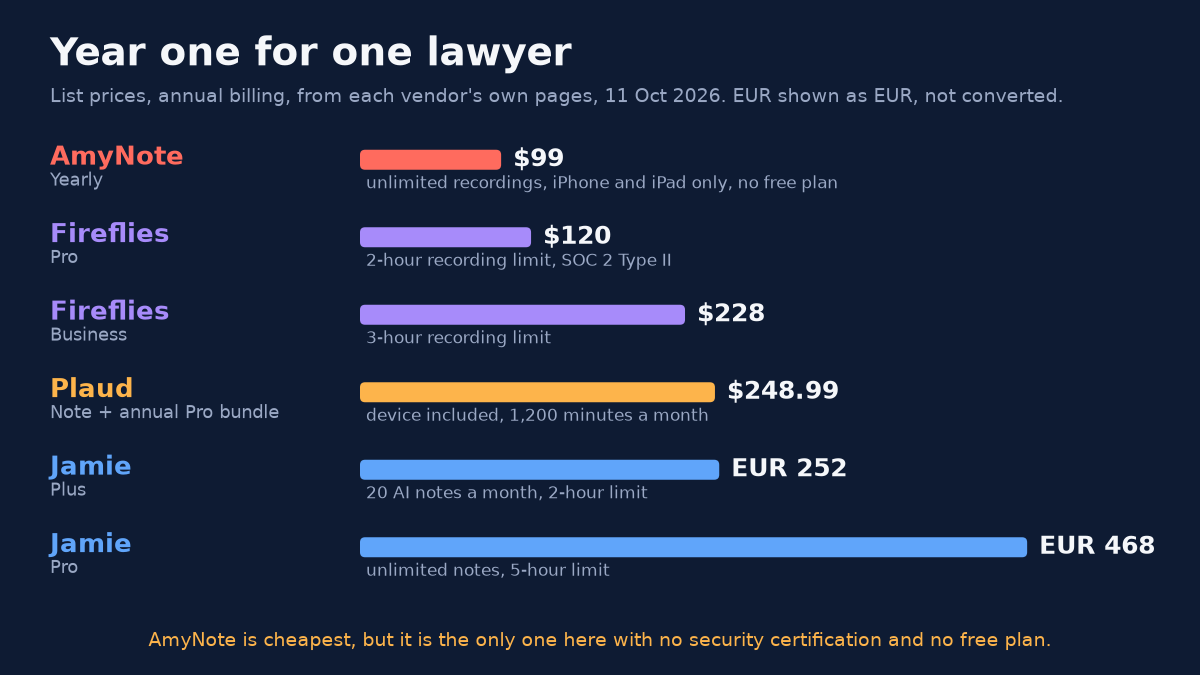
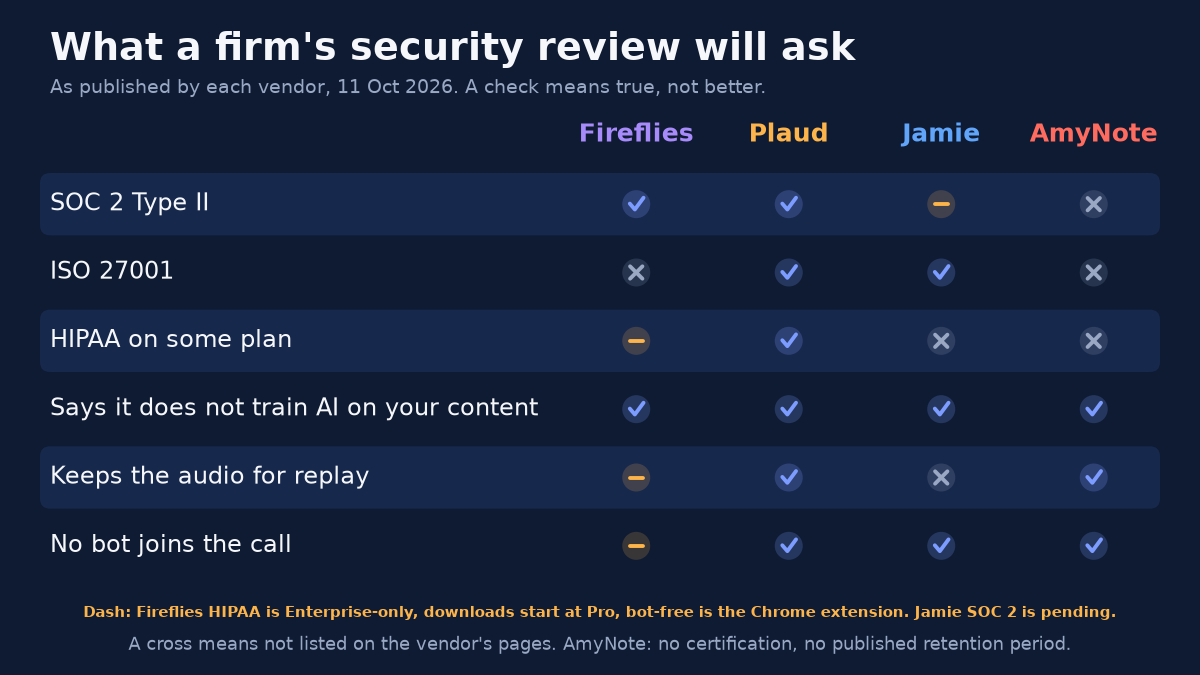
Strengths. Fireflies lists SOC 2 Type II and GDPR compliance on every plan, including Free. Its privacy policy says “We do not use personal information for AI model training” and that it contractually bars its vendors from doing so. A Zero Data Retention policy covers meeting content handled by third-party vendors. A Chrome extension records without a bot joining the call, which matters when opposing counsel would object to an unfamiliar participant. Pro costs $10 per seat a month billed yearly, or $18 monthly.
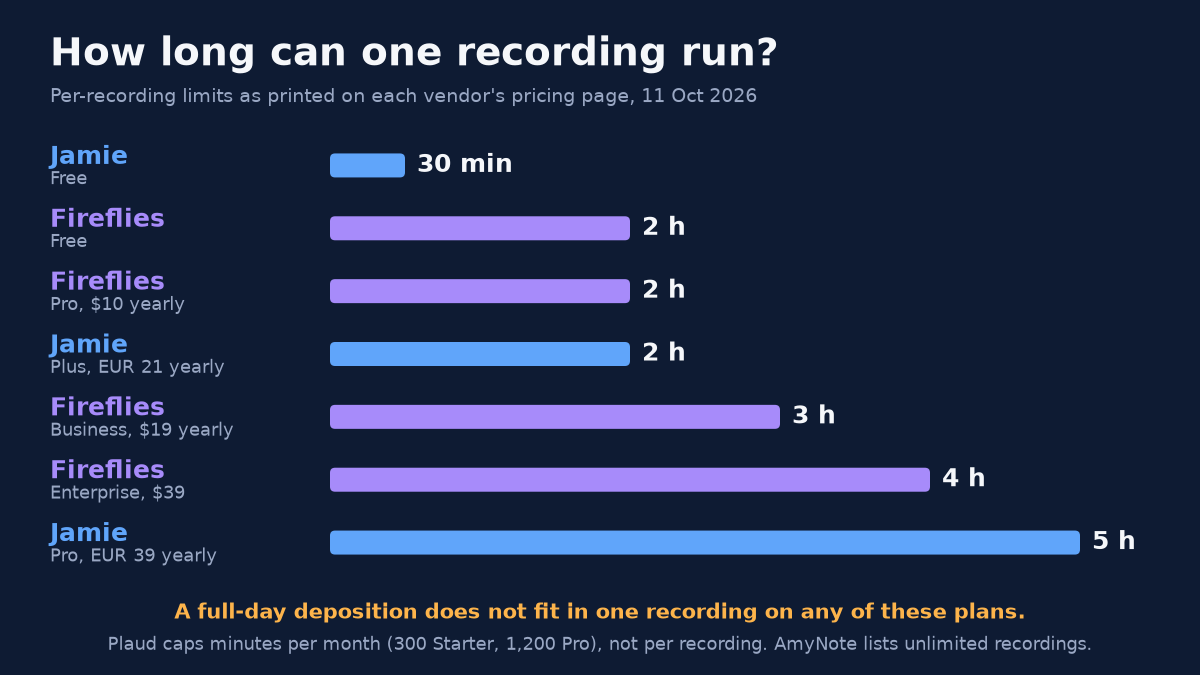
Weaknesses. The pricing table lists a recording limit of 2 hours on Free and Pro, 3 hours on Business ($19 a month billed yearly) and 4 hours on Enterprise ($39, annual only). A full-day deposition does not fit in one recording. HIPAA, custom data retention and private storage are Enterprise-only, recording downloads start at Pro, and sign-in works only through Google or Outlook accounts.
Who it fits. A firm whose client and counsel meetings happen mostly on Zoom, Meet or Teams, that needs a SOC 2 report to clear procurement, and that can either keep sessions under two hours or pay for Business or Enterprise.
Plaud: The Deposition Recorder With the Longest Compliance List
Strengths. Plaud is a pocket recorder plus an app, built for rooms rather than calls. Its pricing page lists “ISO 27001, ISO 27701, GDPR, SOC 2 Type II, HIPAA, and EN 18031” under what all plans include, the strongest sheet in this roundup. Its privacy policy rules out training AI on your content without explicit advance consent. The Unlimited plan is pitched at “doctors, lawyers, journalists” and costs $19.99 a month billed yearly.
Weaknesses. There is no software-only way in. The free Starter plan ships with a device, and the desktop app is listed as requiring one. Plaud Note costs $159, and Plaud’s own Note plus annual Pro bundle is $248.99 for year one. Starter gives 300 transcription minutes a month and Pro gives 1,200, so a busy trial month can hit the cap even though no single recording is limited.
Who it fits. A litigator or in-house team that spends real time in conference rooms, wants a dedicated device on the table rather than a phone, and needs a compliance list long enough to satisfy a cautious client.
Jamie: No Bot, No Stored Audio, EU Hosting
Strengths. Jamie runs on Mac, Windows and iPhone and captures device audio directly, so no bot joins the call. Its security page says “Meeting audio is deleted after transcription”, that data stays within the EEA, Switzerland and the UK, and that neither Jamie nor its model providers train on your data. It holds ISO 27001, and its FAQ names legal firms among its users. In-person meetings are on every plan.
Weaknesses. SOC 2 Type II is listed as “pending”, not achieved. Plans ration length: 30 minutes on Free, 2 hours on Plus (EUR 21 a month billed yearly) and 5 hours on Pro (EUR 39). Deleting the audio cuts both ways. If a client disputes the notes, there is no recording to replay, only the transcript and summary. SSO, SCIM and audit logs are Enterprise-only.
Who it fits. A European practice, or any firm with EU clients, that values data residency and minimal retention above all, and is comfortable treating a transcript rather than an audio file as its working record.
AmyNote: Cheapest and Simplest, With No Certifications
Weaknesses first. For a firm with a security questionnaire, AmyNote publishes no SOC 2, ISO 27001 or HIPAA certification, publishes no retention period, and sells no SSO, SCIM or audit logs. It runs on iPhone and iPad only, does not join Zoom or Teams calls, records no video, and has no free plan, only a 3-day trial.
Strengths. For a solo practitioner or a small practice, AmyNote records the client meeting, a hallway conversation or a speakerphone call, with no bot and no account required for core features. Recordings are unlimited, at $99 a year, $19.99 a month or $12.99 a week. It transcribes 140+ languages and translates into 100+, which helps with immigration and cross-border matters. Playback, reading and exports to PDF, TXT and Word all work offline.
On privacy, transcription runs through OpenAI and Microsoft Azure speech services, and AI analysis is powered by Anthropic’s Claude. AmyNote states plainly that it does not use customer data to train AI models and does not sell meeting content. Audio and text are encrypted in transit with TLS, and the saved library lives on the lawyer’s iPhone or iPad. Local-first is not local-only: when transcription, translation or an AI summary runs, a processing copy may be retained on AmyNote’s cloud infrastructure.
Who it fits. A solo or small-practice lawyer, often in immigration, family or estate work, who meets clients in person or by phone, already carries an iPhone, and does not answer to a firm-wide security review.
Side-by-Side Comparison
| Fireflies | Plaud | Jamie | AmyNote | |
|---|---|---|---|---|
| One recording, cheapest paid plan | 2 hours (Pro) | No per-recording cap; 1,200 min/month (Pro) | 2 hours (Plus) | Unlimited recordings |
| Year one, one lawyer | $120 (Pro) | $248.99 (Note + Pro) | EUR 252 (Plus) | $99 |
| Online calls | Bot or Chrome extension | Desktop app, device required | Yes, no bot | No |
| Built for in-person meetings | Online-first | Yes | Yes | Yes |
| Keeps the audio for replay | Downloads from Pro | Yes | No, deleted | Yes |
| SOC 2 Type II | Yes | Yes | Pending | None |
| HIPAA | Enterprise | All plans | Not listed | None |
How to Choose in Five Minutes
- Ask whether your firm has a security review. If procurement needs a SOC 2 report, Fireflies and Plaud are the only two here that list one as achieved. AmyNote will not pass that review.
- Time your longest session. If depositions or mediations regularly run past two hours, Fireflies Pro and Jamie Plus will split them; Plaud and AmyNote do not cap a single recording.
- Decide whether you want the audio or only the transcript. Jamie deletes audio after transcription. That reduces what is stored, and it also removes the tape you might want to replay when a client remembers things differently.
- Count where last month’s meetings happened. Mostly video calls points to Fireflies or Jamie; mostly rooms and phone calls points to Plaud or AmyNote.
- Settle consent before the first recording. Recording-consent rules vary by jurisdiction, and professional-conduct duties around confidentiality still apply. Tell the people in the room, every time.
The Bottom Line
If meetings are mostly video calls and a security review is mandatory, Fireflies has the cleanest paperwork for the price, but budget for Business or Enterprise if sessions run past two hours. For depositions, mediations and client interviews in the room, Plaud pairs a dedicated recorder with the longest compliance list here, at the cost of buying hardware.
Jamie suits European practices that want no bot and no stored audio, as long as a transcript without a recording is an acceptable record. AmyNote suits the solo or small-practice lawyer who already carries an iPhone, wants the archive on that device and does not need certification paperwork. It is the wrong pick for a firm that must hand a vendor questionnaire to IT. It is on the App Store with a three-day trial.
Originally published as an X Article by @AmyNoteApp.