A sales-heavy team standardizing on Avoma can quietly land at over $70 per seat per month once add-ons stack. Fellow's Enterprise plan starts at $25 per user. AmyNote sits outside that bracket entirely with no per-seat tiering and no add-on shelf. This comparison looks at where each tool actually earns its price tag, and where the line item starts to look soft.
Quick Verdict
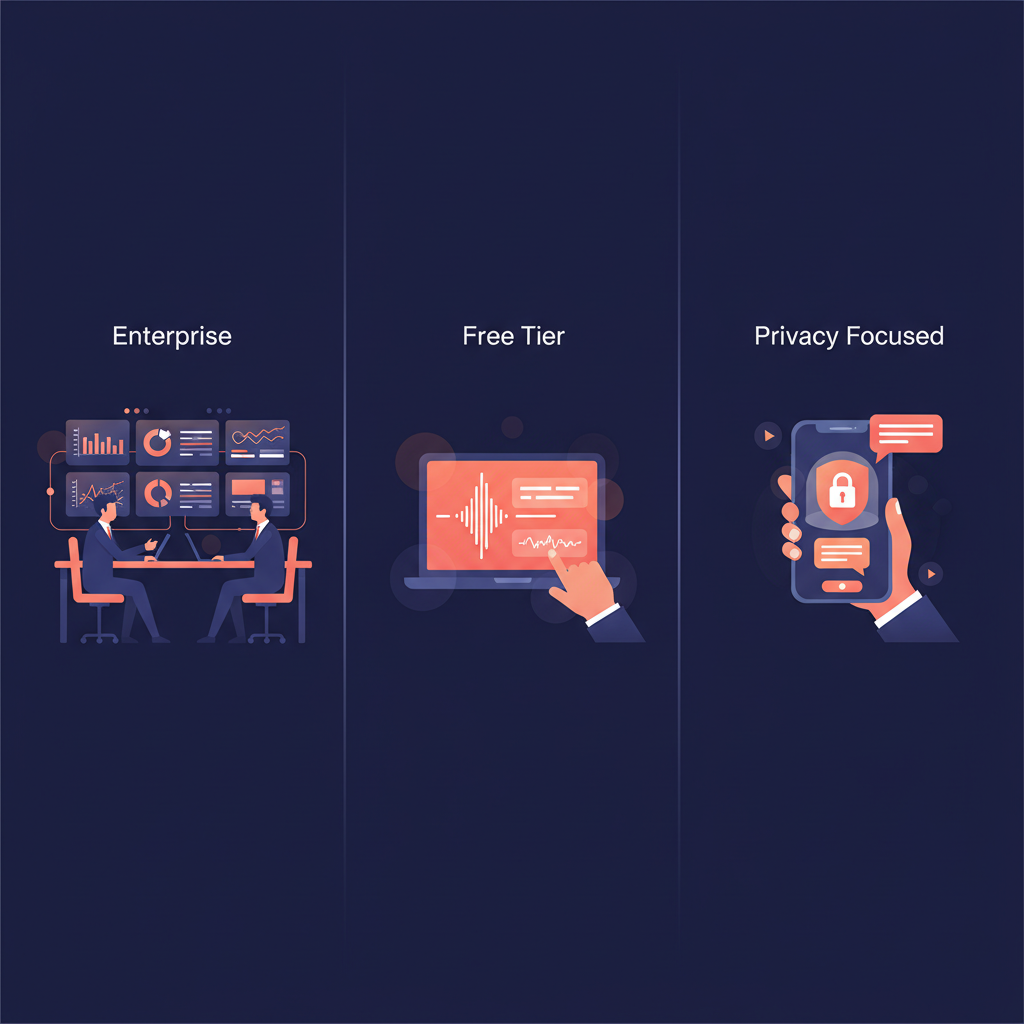
Avoma is the right pick if a sales org actually uses MEDDIC or SPICED scoring, custom AI scorecards, and pipeline forecasting. Outside that workflow, the add-on math gets painful fast.
Fellow is the most defensible pick for an enterprise that needs SOC 2 Type II, HIPAA, data residency, and 50+ tool integrations under one license. Strong language coverage too.
AmyNote is the right pick for individuals and small teams who want zero-training privacy guarantees, in-person capture, and 120+ languages without a per-seat bill or an add-on shelf.
What We Compared
Pricing transparency, recording approach, integrations, language coverage, privacy posture, and what each tool gives up to hit its price point. Pricing reflects published rates as of May 2026. The reading we wanted was the all-in cost a real team will actually pay after the first quarter — not the headline number on the marketing page.
Avoma: Strengths and Weaknesses
What it's built for
Avoma is a sales-first conversation and revenue intelligence platform with a 4.6/5 rating across 1,355 G2 reviews. Teams report saving 4+ hours per week on note-taking, follow-up emails, and CRM data entry. The platform is positioned squarely at mid-market and upper-mid-market sales orgs that already operate with a defined methodology and want the meeting layer to feed that methodology automatically.
Strengths
Automatic detection of MEDDIC, SPICED, and NEAT methodology fields. Custom AI scorecards with 100% call coverage. CRM sync that typically lands within 5 to 30 minutes after a meeting. A 14-day free trial of the Organization tier with all add-ons, no credit card required. For a team that runs structured deal reviews every Friday, the value is concrete: scorecards fill themselves, deal-stage criteria get scored against the actual conversation, and the rep's pipeline notes match what was said on the call.
Weaknesses
Pricing compounds. The Startup base plan is $19 per seat per month on annual billing, but Conversation Intelligence is a $29 add-on and Revenue Intelligence is another $29. A fully-loaded sales rep lands at $77 per seat per month on annual, or higher on monthly billing. Bundling all three add-ons earns 15% off, which softens the blow but doesn't change the structure.
Reliability is the most-cited complaint on G2: the meeting bot sometimes fails to join, joins late, or drops mid-call. Some users have reported CRM sync delays of 60+ minutes, which kills the value for live pipeline reviews. The dependency on the bot also means coffee meetings, in-person customer visits, and phone calls fall outside the capture surface entirely.
Best for
Mid-market sales orgs that already run a structured methodology and will use the scorecards every week. If MEDDIC fields are not already part of the rep workflow, the $77 fully-loaded seat is paying for software that won't get opened.
Fellow: Strengths and Weaknesses
What it's built for
Fellow positions itself as the enterprise-governed AI meeting assistant. It supports both bot and botless recording, and ships with the heaviest compliance stack in the category. Where Avoma is a sales tool that captures meetings, Fellow is a meeting tool that earns its keep in IT, security, and procurement reviews.
Strengths
Transcription claims 95%+ accuracy across 92 languages. Integrations with 50+ tools including Salesforce, HubSpot, Asana, Linear, Jira, Glean, Zapier, and Slack. SOC 2 Type II, HIPAA, GDPR, plus data residency options. Transcript redaction, granular permission controls, and audit logging are first-class features. Fellow does not train models on user data. A free plan exists for teams up to 10 users with core AI transcription, summaries, and action items included — a rarity at the enterprise end of the category.
Weaknesses
The paid tiers ramp quickly. Team is $7 per user per month, Business is $15, and Enterprise is $25 with a 10-user minimum. Botless recording is desktop-only, so mobile capture is limited to the bot path. Several integrations and the strongest compliance features sit on Business and Enterprise tiers, so a small team that wanted Fellow primarily for security will pay above the entry price to actually get it.
Best for
Mid-to-large companies in regulated industries that need SOC 2, HIPAA, redaction, and audit logging in the same SKU. Healthcare, financial services, legal, and government adjacency teams cluster here for a reason.
AmyNote: Strengths and Weaknesses
What it's built for
A mobile-first AI note-taker for individuals and small teams. Designed around the case where the meeting is in person, on a phone call, or on any platform a bot cannot reach. The product takes a deliberate position: meetings happen in cafes, conference rooms, clinics, courthouses, and customer offices, and the tool that captures them should not require a third-party participant on the call.
Strengths
Transcription runs through OpenAI's Speech API and AI analysis through Anthropic's Claude Opus. Both providers contractually guarantee zero training on user data. Audio is encrypted in transit; processing copies may be retained to deliver and recover requested features. Transcripts and recordings are stored locally on the user's device with encrypted transport.
120+ languages with real-time translation, broader than Fellow's 92 and far ahead of category averages. Speaker identification carries across sessions, so the same colleague is not relabeled "Speaker 2" in every new meeting. No bot ever joins a call. No hardware required. 3-day free trial, no credit card.
Weaknesses
No desktop app yet. No CRM integrations, so Avoma's MEDDIC field updates and Fellow's HubSpot sync are both out of scope. No native video recording. Smaller brand recognition than either of the other two. Team and enterprise admin features are still maturing, so a 200-seat compliance procurement is not the right fit today.
Best for
Solo professionals, consultants, in-person interviewers, and small teams whose ceiling on per-seat tooling spend is firm.
Side-by-Side Comparison
| Avoma | Fellow | AmyNote | |
|---|---|---|---|
| Entry price (annual) | $19/seat (compounds to $77 with add-ons) | Free up to 10 users; $7-$25/seat after | Flat, no per-seat tiering |
| Recording approach | Bot-based | Bot or botless on desktop | Bot-free, on-device |
| Languages | Major business languages | 92 languages, 95%+ accuracy | 120+ with real-time translation |
| CRM & integrations | Deep CRM sync, MEDDIC/SPICED detection | 50+ (Salesforce, HubSpot, Linear, Jira) | None today |
| Compliance posture | SOC 2 | SOC 2 Type II, HIPAA, GDPR, data residency, redaction, audit logging | Contractual zero-training, local storage, encrypted transport |
| Free trial | 14 days, all add-ons | Free plan up to 10 users | 3 days, no credit card |
| Best fit | Sales-heavy mid-market | Regulated enterprise | Individuals, small teams, in-person work |
Where Each Tool Wins
Avoma wins for sales orgs that live in a methodology. If reps run MEDDIC or SPICED scorecards every Friday and the CRM is the source of truth, the $77 fully-loaded seat earns out — barely — through saved manual entry and faster pipeline reviews. The rest of the time it is paying for software that does not get opened.
Fellow wins for compliance-led procurement. SOC 2 Type II, HIPAA, GDPR, redaction, audit logging, and data residency in one SKU is the entire reason Fellow gets approved when other meeting tools do not. The Enterprise minimum of 10 seats at $25 each is the price of admission for a stack that legal will sign.
AmyNote wins for everything that does not happen in the Zoom rectangle. Coffee meetings. In-person interviews. Site visits. Phone calls. Multilingual customer conversations. The category of work where the bot was never going to show up. And it wins for anyone whose ceiling on per-seat tooling is firm and whose privacy posture is non-negotiable.
The Bottom Line
The honest test for any premium AI meeting tool is whether the workflow it enables is actually run every week. Avoma earns its $77 fully-loaded seat when a rep lives inside MEDDIC scorecards and CRM forecasting. Fellow earns its $25 Enterprise seat when SOC 2 Type II, HIPAA, and data residency are non-negotiable line items. Otherwise, the per-seat math compounds against the buyer.
For solo professionals, consultants, and small teams who care more about privacy and in-person capture than CRM automation, AmyNote is the more honest fit. No bot, no hardware, no per-seat tier ramp, and zero-training guarantees in writing from both AI providers. It will not replace a revenue intelligence platform, and it does not pretend to. What it does replace is the assumption that real meeting capture has to start at $19 per seat and end at $77.
Originally published as an X Article: Avoma vs Fellow vs AmyNote on X.