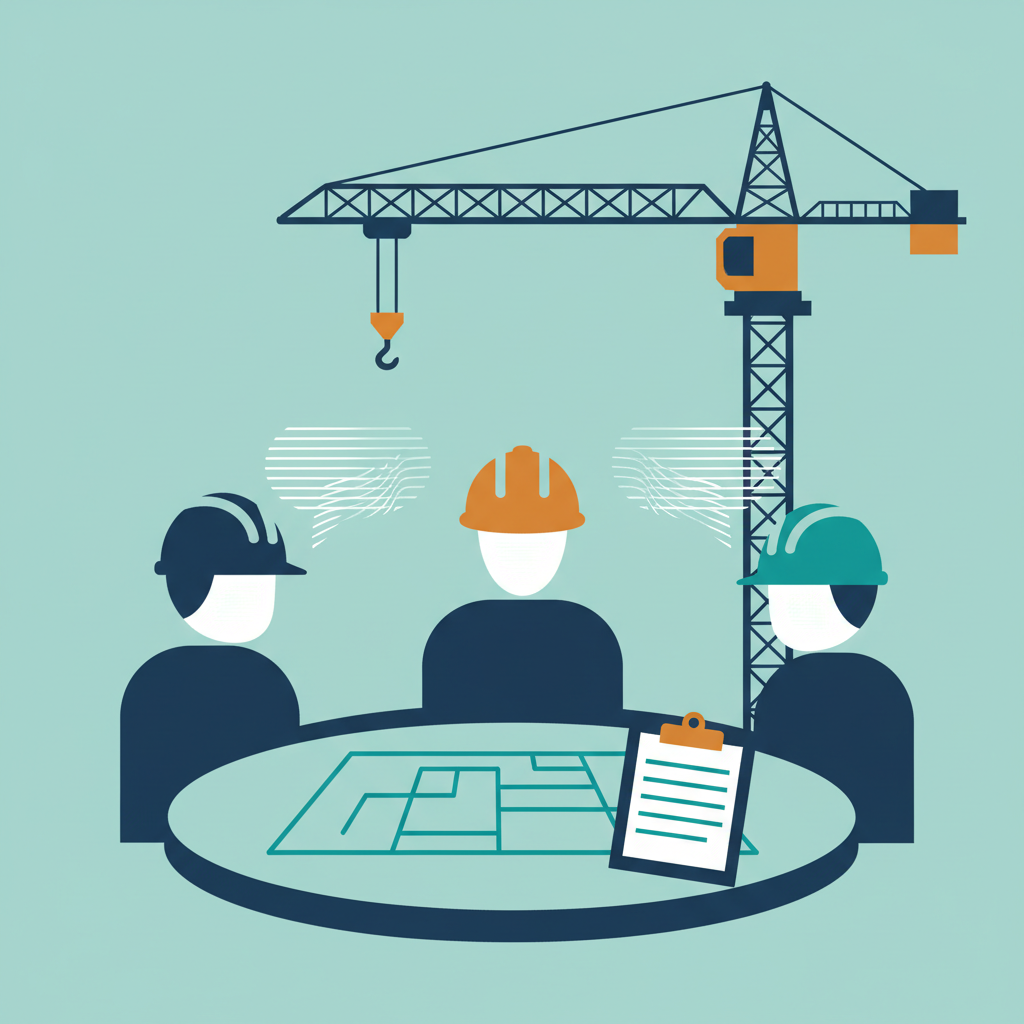
An architect sits across from a client reviewing facade options for a mixed-use development. The client points at Option B, says "let's go with the curtain wall system — but swap the mullion profile to something slimmer." The architect nods, makes a mental note, and moves on to the next agenda item. Three months later, the curtain wall is fabricated. The client says they never approved that mullion change. The rework costs $340,000.
This scenario plays out across architecture and engineering firms every week. Design review meetings generate dozens of verbal decisions — material substitutions, finish selections, spatial adjustments — that never make it into formal documentation. The result is not just rework. It is professional liability exposure that threatens the financial stability of even well-run firms.
The Verbal Approval Problem
Architecture firms operate in a uniquely documentation-heavy environment. Every design decision carries contractual weight. Yet the meetings where these decisions actually happen — design reviews, owner-architect-contractor (OAC) meetings, consultant coordination sessions — rely on handwritten notes and memory.
The numbers are brutal. A typical design review generates 15-25 discrete decisions in 90 minutes. The project architect captures maybe 60% in their notes. The rest lives only in the memories of people who will remember it differently in six weeks.
Scope creep starts here. When a client verbally requests "just a small change" to the lobby layout, that verbal request cascades through structural, MEP, and interior design coordination. Without a timestamped record of who requested what, the firm absorbs the cost of changes they should be billing as additional services.
Professional liability claims follow. The AIA reports that documentation disputes are among the top triggers for E&O claims against architecture firms. "The client approved this in the March 12th meeting" means nothing without a verifiable record.
The Cascade Effect of Undocumented Decisions
What makes architecture uniquely vulnerable is the interdisciplinary cascade. A single verbal decision in a design review rarely stays contained within one discipline. Consider what happens when a client says "let's raise the ceiling height in the lobby by two feet" during an OAC meeting:
- Structural engineering needs to verify that the revised floor-to-floor height works with the existing column grid and beam depths.
- MEP coordination must adjust ductwork routing, sprinkler head placement, and lighting layouts for the new ceiling plane.
- Interior design recalculates wall proportions, millwork heights, and signage placement.
- Cost estimation needs to reprice the facade system, curtain wall dimensions, and any affected structural steel.
If the original verbal request is not captured with precision — who said it, when, and in what context — downstream teams work from assumptions. The structural engineer heard "raise the ceiling" but not the follow-up caveat about maintaining the existing parapet height. The MEP consultant never got the memo at all. By the time the discrepancy surfaces in a coordination model, weeks of work may need to be revised.
This is not a hypothetical edge case. It is the default failure mode for firms that rely on traditional meeting minutes.
Why Meeting Minutes Don't Work
Most firms rely on someone typing up meeting minutes after the fact. This approach fails in predictable ways.
- Delay kills accuracy. Minutes written hours or days later miss nuance. "Client prefers warmer tones" does not capture "client specifically rejected the Venetian plaster sample and asked for the limewash finish at $12/sq ft instead of $8/sq ft."
- The note-taker misses context. Junior staff assigned to take notes often lack the technical knowledge to recognize which verbal decisions carry contractual significance. A material substitution that sounds casual may have a six-figure cost implication.
- Disputes become he-said-she-said. Without a verbatim record, meeting minutes are just one person's interpretation. They hold up poorly in mediation or litigation.
- Nobody reads them. Even when minutes are thorough, the 48-hour turnaround means decisions are already being acted on before minutes are distributed. The coordination gap is baked into the process.
The Cost of Getting It Wrong
The financial exposure from undocumented design decisions compounds across the lifecycle of a project. Consider three common scenarios:
Rework from disputed approvals. When a client disputes a material selection or spatial decision that was verbally approved, the firm often absorbs the rework cost to preserve the relationship. On a mid-size commercial project, a single disputed facade decision can trigger $200,000-$500,000 in rework — fabrication, installation labor, and schedule delays.
Unbilled additional services. The AIA standard contract distinguishes between basic services and additional services. When a client requests changes verbally and there is no timestamped record, firms struggle to justify billing those changes as additional services. Over the life of a project, this leakage can represent 10-15% of the total fee.
E&O claims and insurance costs. Professional liability insurance premiums for architecture firms are directly tied to claims history. A single documentation-related E&O claim can increase premiums for years. The cost of the claim itself — legal fees, settlements, deductibles — is often just the beginning.
What Actually Works
The gap between verbal decisions and documented records is a transcription problem — and AI transcription has finally caught up to the complexity of architectural vocabulary.
Domain-Specific Accuracy
Terms like "curtain wall mullion," "vapor barrier detailing," "Revit clash detection," and "LEED commissioning agent" are not in general dictionaries. AmyNote uses OpenAI's latest Speech API, which handles architectural and engineering terminology with the accuracy that general transcription tools cannot match. When a structural engineer says "W14x22 wide-flange beam," the transcript reflects exactly that — not a garbled approximation.
Speaker Identification That Changes the Liability Equation
When the transcript shows "Client (John Martinez): Go ahead with the Type III curtain wall" with a timestamp, that is a verifiable record. It transforms a he-said-she-said dispute into a documented decision with attribution.
AmyNote's cross-session speaker memory means it recognizes returning participants — the structural engineer, the MEP consultant, the owner's rep — without re-introduction every meeting. Over the course of a 14-month project with biweekly OAC meetings, that adds up to a complete, searchable record of every decision and who made it.
AI-Powered Search Across All Project Meetings
Six months into a project, someone asks "when did we decide to switch from steel to glulam for the atrium beams?" Instead of scrubbing through notes or emailing the project team, AmyNote's semantic search — powered by Anthropic's Claude — finds that moment across hundreds of hours of meeting recordings in seconds. For dispute resolution, this is transformative. For project continuity when team members change, it is essential.
Privacy Built for Professional Practice
Architecture firms handle proprietary design information, client financial data, and competitively sensitive project details. Both OpenAI and Anthropic contractually guarantee zero training on user data. Audio is encrypted in transit; processing copies may be retained to deliver and recover requested features. Transcripts are stored locally on device with encrypted transport. Cloud processing copies are handled under the controls described in AmyNote’s Privacy Policy. No proprietary project details feeding into model training pipelines.
Getting Started
Design review meetings are too high-stakes for handwritten notes and delayed minutes. AmyNote captures every verbal decision with speaker attribution, timestamps, and AI-powered search — built on OpenAI transcription and Anthropic Claude analysis, with zero-training guarantees from both providers. Three-day free trial, no credit card required.
Originally published as an X Article.