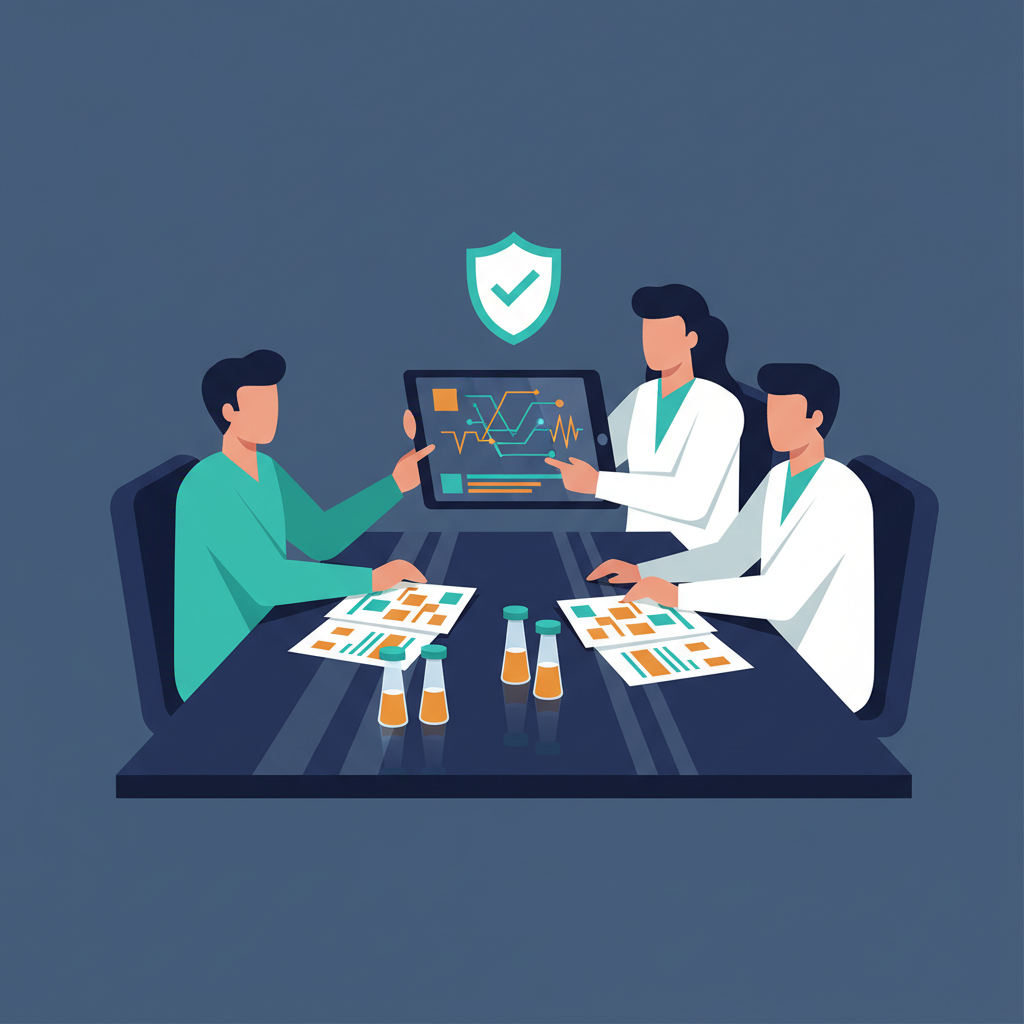
A clinical research associate flies to a trial site for a routine monitoring visit. During the meeting, the principal investigator mentions a pattern of Grade 2 adverse events that "seem higher than expected." The medical monitor on the call recommends adjusting the dosing schedule. The CRA nods, takes a few handwritten notes, and moves on to the next agenda item.
Three months later, an FDA inspector asks for documentation of when the safety signal was first discussed and what actions were taken. The CRA's notes say "AE discussion — follow up." That is all the evidence that exists for a decision that affected 200 patients across 15 sites.
This is not a rare scenario. It is the default operating mode for most clinical trial teams.
The Documentation Problem in Clinical Trials
Clinical trials generate an enormous volume of verbal decisions. Investigator meetings, data safety monitoring board (DSMB) calls, sponsor-site visits, and cross-functional team syncs all produce critical information that shapes trial conduct. Protocol deviations get discussed. Enrollment strategies shift. Safety signals emerge in conversation before they appear in formal reports.
The problem is that most of this verbal information never makes it into the trial master file with any precision. CRAs write visit reports from memory hours or days after the meeting. Medical monitors summarize hour-long safety discussions into three bullet points. Study managers capture action items but lose the context behind them — the reasoning, the caveats, the dissenting opinions that informed the final decision.
The scale of the gap is staggering. A single Phase III trial may involve hundreds of site visits, dozens of DSMB calls, and thousands of cross-functional discussions over a period of years. Each one generates verbal decisions that should be documented. Each one is typically captured through handwritten notes, selective memory, and delayed reconstruction.
The regulatory cost is real. FDA 483 observations increasingly cite inadequate documentation of decision-making processes. When an inspector asks why a protocol amendment was delayed by six weeks, "we discussed it in a meeting" is not an acceptable answer without a verifiable record of that discussion. The expectation is shifting from "did you do it" to "can you prove when and how the decision was made."
Why Current Approaches Fail
Clinical trial teams are not careless. They work hard at documentation. The problem is structural — the tools and processes available to them are fundamentally mismatched to the task.
- Handwritten notes are selective. CRAs capture what they think matters in the moment, not what an auditor will ask about two years later. Critical context gets filtered out through the unavoidable lens of real-time judgment. The safety signal that seems minor today may be the central question in a future inspection.
- Meeting minutes arrive late. When someone writes minutes 48 hours after a three-hour investigator meeting, they are reconstructing from memory, not documenting. Details blur. Nuance disappears. Attribution becomes uncertain — who said what, and in what context, is exactly the kind of information that fades fastest.
- Recording without transcription creates dead storage. Some teams record meetings but never transcribe them. A 90-minute audio file that nobody can search is functionally useless during an audit. An inspector is not going to listen to hundreds of hours of recordings to find the one conversation about a dosing change.
- Generic transcription tools fail on pharma terminology. Standard speech-to-text mangles terms like pharmacokinetics, thrombocytopenia, immunogenicity, and RECIST criteria. If the transcript reads "farm a co kinetics," it is worse than no transcript at all — it creates a record that undermines confidence in the entire documentation system.
- Enterprise meeting tools require bots. Most AI meeting assistants are designed for Zoom and Teams calls. They send a visible bot that joins the meeting. For sensitive sponsor-site discussions, DSMB deliberations, and regulatory strategy calls, many teams refuse to allow a third-party bot into the room.
What Actually Works
The gap is not effort. Clinical trial teams work hard at documentation. The gap is between what gets said in meetings and what makes it into searchable, auditable records. Closing that gap requires a different kind of tool — one built for the specific challenges of clinical trial documentation.
AI Transcription Built for Technical Vocabulary
AmyNote uses OpenAI's latest Speech API, which handles domain-specific pharma terminology with high accuracy. Terms like adverse event of special interest, dose-limiting toxicity, informed consent deviation, and DSMB recommendation come through correctly — not as garbled approximations. This matters because a transcript is only useful if the people reading it can trust what it says.
The difference between "thrombocytopenia" and "thrombo sigh toe penia" in a transcript is the difference between a usable audit record and a liability. When regulatory teams review documentation, accuracy of technical terms is not a nice-to-have — it is the baseline requirement for the document to have any evidentiary value.
Speaker Identification for Multi-Party Trial Meetings
When the principal investigator, medical monitor, biostatistician, and CRA are all on the same call, knowing who raised a safety concern versus who approved a protocol change is not optional. In regulatory terms, attribution is as important as content.
AmyNote's cross-session speaker memory recognizes participants across meetings, building a reliable attribution record over time. Name participants once in the first monitoring visit, and every subsequent meeting with those speakers is automatically labeled. For trial teams that interact with the same site investigators repeatedly over months or years, this eliminates a significant source of manual effort and attribution error.
AI-Powered Search Across All Trial Meetings
This is where the real audit-readiness emerges. Powered by Anthropic's Claude, AmyNote lets you search semantically across months of meeting transcripts. When an inspector asks "when was the enrollment pause first discussed," you can surface the exact meeting, the exact speaker, and the exact words used — in seconds.
This transforms the inspection dynamic. Instead of scrambling to reconstruct timelines from fragmentary notes and uncertain memories, trial teams can point to a searchable, attributed record of every discussion. The shift from "I think we discussed it sometime in Q3" to "here is exactly what Dr. Chen said on September 14th at 2:47 PM" is the difference between a finding and a clean audit.
Privacy Architecture That Meets Pharma Compliance Standards
Clinical trial data carries some of the strictest privacy requirements in any industry. Patient identifiers, proprietary trial designs, and competitive intelligence all flow through sponsor-site discussions. The AI tools handling this data must meet a higher bar than consumer-grade transcription services.
Both OpenAI and Anthropic contractually guarantee zero training on user data. Audio is encrypted in transit; processing copies may be retained to deliver and recover requested features. Transcripts are stored locally on the user's device with encrypted transport. Cloud processing copies are handled under the controls described in AmyNote’s Privacy Policy. No clinical trial data feeding into model training pipelines. Provider retention follows the applicable API or enterprise terms.
For pharma compliance teams evaluating AI tools, this architecture addresses the core concerns: data sovereignty, training exclusion, and minimized third-party exposure.
The Audit-Readiness Shift
The traditional approach to clinical trial documentation treats meetings as events that produce summaries. The AI-assisted approach treats meetings as primary source material — searchable, attributed, and preserved with the precision the regulatory environment demands.
| Traditional Approach | AI-Assisted Approach | |
|---|---|---|
| Capture method | Handwritten notes, delayed minutes | Real-time transcription with speaker labels |
| Terminology accuracy | Dependent on note-taker | Domain-trained speech models |
| Attribution | Often missing or uncertain | Automatic speaker identification |
| Searchability | Manual review of documents | Semantic AI search across all meetings |
| Audit response time | Days to weeks | Seconds |
Getting Started
AmyNote brings together OpenAI's Speech API for transcription and Anthropic's Claude for AI-powered search and summaries. Both providers guarantee zero data training. For clinical trial teams, this means every sponsor-site meeting, every safety call, and every investigator discussion becomes a searchable, auditable record — without requiring a bot in the room, without sending data to model training pipelines, and without the manual effort of reconstructing conversations from memory.
Try it free for 3 days, no credit card required. Download at amynote.app.
Originally published as an X Article.